Luyện nghe Tiếng Anh 10 Global Success Unit 2
🎧 Luyện nghe Tiếng Anh lớp 10 Unit 2 Human and the Environment có infographic là tài liệu hỗ trợ học sinh rèn kỹ năng nghe hiểu, củng cố từ vựng và nắm chắc nội dung chủ đề Con người và Môi trường. Tài liệu kết hợp bài tập nghe với phiếu infographic trực quan, giúp việc ôn tập trở nên dễ nhớ và hiệu quả hơn.
👉 Tải ngay tài liệu luyện nghe Tiếng Anh 10 Unit 2 Human and the Environment có infographic để luyện Listening, kiểm tra đáp án và hệ thống kiến thức một cách khoa học!
Luyện nghe tiếng Anh 10 unit 2 Human and the Environment
Bài tập luyện nghe tiếng Anh 10 Global Success unit 2 Human and the Environment có đáp án bao gồm nhiều bài tập luyện nghe tiếng Anh lớp 10 khác nhau giúp các em học sinh ôn tập hiệu quả.
Phiếu bài tập Luyện nghe tiếng Anh 10 Unit 2 Global Success - Dạng hình ảnh
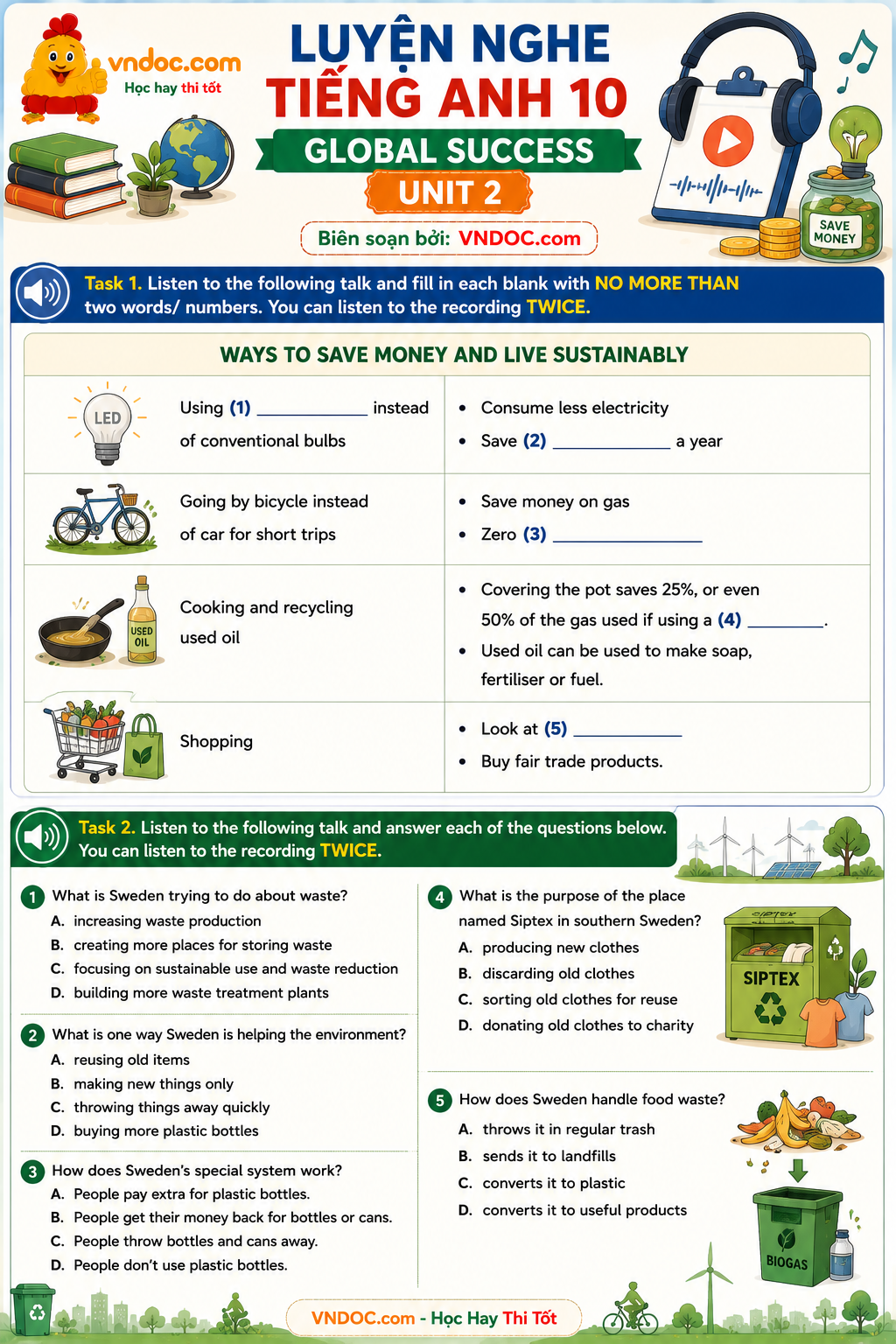
Phiếu bài tập Luyện nghe tiếng Anh 10 Unit 2 Global Success - File Word
Task 1. Listen to the following talk and fill in each blank with NO MORE THAN two words/ numbers. You can listen to the recording TWICE.
|
WAYS TO SAVE MONEY AND LIVE SUSTAINABLY |
|||
|
Using (1) ______ instead of conventional bulbs |
Going by bicycle instead of car for short trips |
Cooking and recycling used oil |
Shopping |
|
- Consume less electricity - Save (2) ______ a year |
- Save money on gas - Zero (3) _______ |
- Covering the pot saves 25%, or even 50% of the gas used if using a (4) ____. - Used oil can be used to make soap, fertiliser or fuel. |
- Look at (5) ______ - Buy fair trade products. |
Task 2. Listen to the following talk and answer each of the questions below. You can listen to the recording TWICE.
1. What is Sweden trying to do about waste?
A. increasing waste production
B. creating more places for storing waste
C. focusing on sustainable use and waste reduction
D. building more waste treatment plants
2. What is one way Sweden is helping the environment?
A. reusing old items
B. making new things only
C. throwing things away quickly
D. buying more plastic bottles
3. How does Sweden’s special system work?
A. People pay extra for plastic bottles.
B. People get their money back for bottles or cans.
C. People throw bottles and cans away.
D. People don’t use plastic bottles.
4. What is the purpose of the place named Siptex in southern Sweden?
A. producing new clothes
B. discarding old clothes
C. sorting old clothes for reuse
D. donating old clothes to charity
5. How does Sweden handle food waste?
A. throws it in regular trash
B. sends it to landfills
C. converts it to plastic
D. converts it to useful products
Task 3. Listen to the podcast about climate change and do the following tasks.
Part 1. Decides which statement is TRUE or FALSE.
Question 1. By 2050, drought and water shortages will impact billions of people.
Question 2. Solar and wind power can help human cut carbon emission by a-third.
Question 3. Denmark is building the world biggest offshore wind farm.
Question 4. Cities refuse to pave streets with smog eating concrete because of high price.
Question 5. Individuals’ contribution is not sufficient to make difference.
Part 2. Choose the best answer.
1. How many of the hottest 15 years on record have occurred in the last two decades?
A. 10
B. 12
C. 14
D. 15
2. By 2050, drought and chronic water shortages could affect about ______ people.
A. 100 million
B. 500 million
C. 1 billion
D. 2 billion
3. What percentage of Germany’s electricity currently comes from renewable energy?
A. 17%
B. 27%
C. 50%
D. 80%
4. What type of energy can Denmark produce more than it can use?
A. Solar energy
B. Nuclear energy
C. Wind energy
D. Water energy
5. What is being built in England?
A. A solar power station
B. The world’s biggest offshore wind farm
C. A new public building
D. A recycling centre
Part 3. Fill in the blanks.
1. Solar and wind power could reduce the world's yearly carbon emissions by ______.
2. Paris installed street tiles that ______ energy from foot traffic.
3. Some cities are using ______ concrete to reduce smog.
4. If every American driver drove 10 miles less each week, more than ______ billion pounds of carbon could be eliminated from the air each year.
5. Real change is possible when countries, companies, cities, and ______ work together.
Task 4. Listen about air pollution and do the following tasks.
Part 1: Listen and Choose the Correct Answer (A, B, C, or D)
1. What is air pollution?
A. A natural weather phenomenon
B. Contamination of the environment by harmful agents
C. A type of disease
D. A method of protecting the atmosphere
2. Which of the following is NOT mentioned as a source of air pollution?
A. Motor vehicles
B. Forest fires
C. Solar panels
D. Industrial facilities
3. Which pollutant is mentioned in the passage?
A. Oxygen
B. Hydrogen
C. Nitrogen dioxide
D. Helium
4. How many people are estimated to die from air pollution each year?
A. Three million
B. Five million
C. Seven million
D. Ten million
5. According to WHO data, what percentage of the world's population breathes polluted air?
A. 75%
B. 85%
C. 90%
D. 99%
Part 2: Listen and decide whether the statements are True (T) or False (F).
1. Air pollution only affects outdoor environments. ________
2. Household combustion devices can cause air pollution. ________
3. Carbon monoxide is one of the pollutants mentioned. ________
4. High-income countries suffer from the highest exposure to air pollution. ________
5. Air pollution can increase the risk of heart disease and lung cancer. ________
Part 3: Listen and complete the sentences with NO MORE THAN THREE WORDS.
1. Air pollution is the contamination of the indoor or outdoor __________.
2. Common sources of air pollution include motor vehicles and __________.
3. Outdoor and indoor air pollution cause respiratory and other __________.
4. WHO data shows that almost all of the global population breathe air that exceeds WHO __________.
5. Air pollution poses a major threat to health and __________.
Đáp án và Audio script có trong File Tải. Mời bạn đọc click Tải về để download trọn bộ đề luyện nghe nhé!
Trên đây là Bài tập Listening tiếng Anh 10 unit 2 Global Success có đáp án. VnDoc.com hy vọng rằng tài liệu Bài tập Luyện nghe tiếng Anh 10 theo từng Unit trên đây sẽ giúp các em ôn tập hiệu quả. 👉 Tải tài liệu ngay để luyện nghe hiệu quả, củng cố từ vựng và tự tin hơn khi học Unit 2 – Human and the Environment!
Ngoài ra, VnDoc.com đã đăng tải bộ tài liệu Học tốt tiếng Anh 10 cả năm tại: