Luyện nghe Tiếng Anh 12 Global Success Unit 3
Luyện nghe Tiếng Anh 12 Unit 3 Green Living - Global Success cung cấp hệ thống bài tập Listening giúp học sinh lớp 12 rèn luyện khả năng nghe hiểu qua chủ đề sống xanh và bảo vệ môi trường. Đây là tài liệu phù hợp để học sinh tự học, ôn tập Unit 3, chuẩn bị kiểm tra Tiếng Anh 12 và củng cố từ vựng liên quan đến Green Living.
Luyện nghe Tiếng Anh 12 Global Success Unit 3 Green Living có đáp án
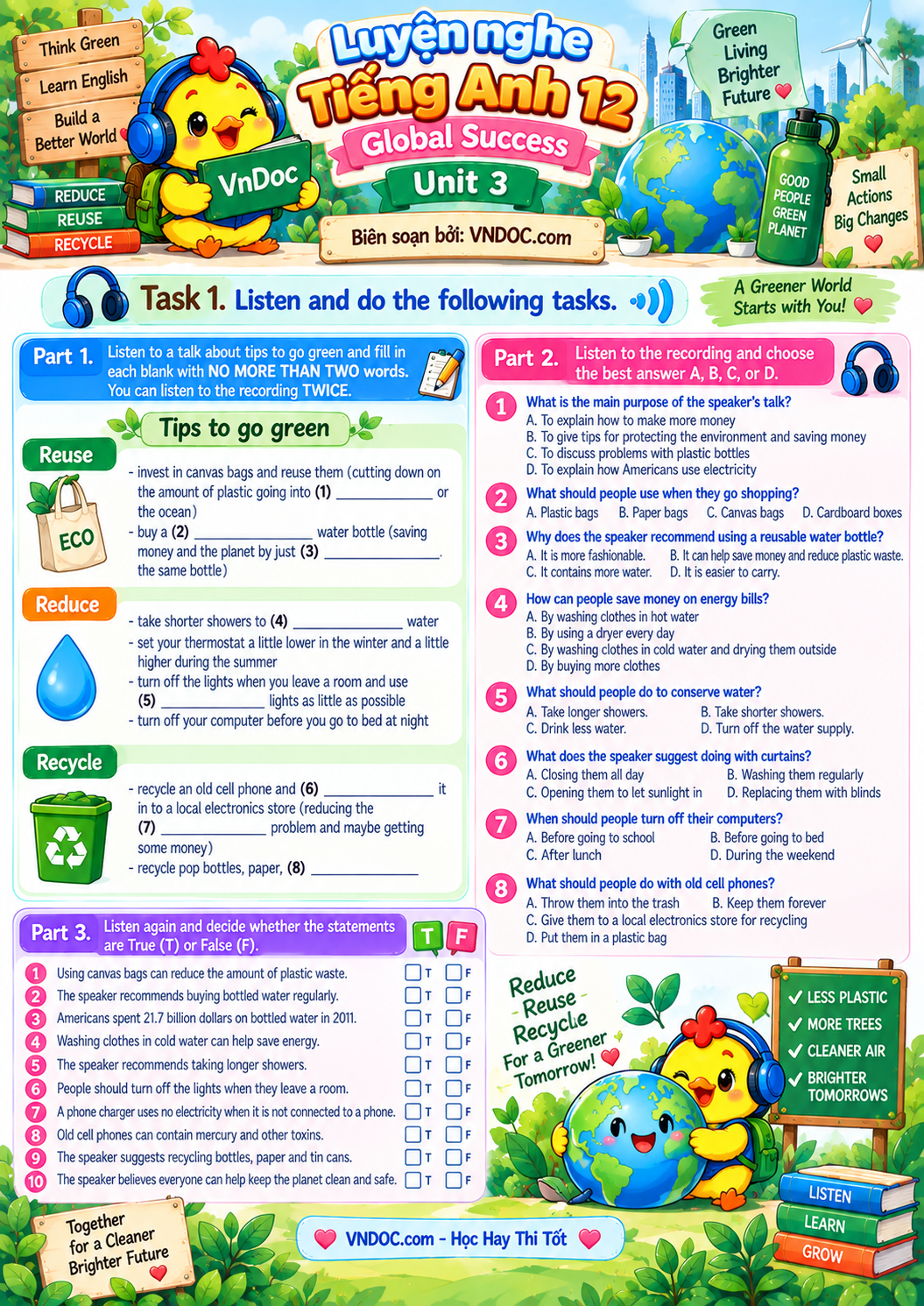
Phiếu bài tập nghe tiếng Anh lớp 12 Global Success unit 3 - dạng hình ảnh
Phiếu bài tập nghe tiếng Anh lớp 12 Global Success unit 3 - file word
Task 1. Listen and do the following tasks.
Part 1. Listen to a talk about tips to go green and fill in each blank with NO MORE THAN TWO words. You can listen to the recording TWICE.
|
|
Tips to go green |
|
Reuse |
- invest in canvas bags and reuse them (cutting down on the amount of plastic going into (1) _______ or the ocean) - buy a (2) ____________ water bottle (saving money and the planet by just (3) _____________ the same bottle) |
|
Reduce |
- take shorter showers to (4) ___________ water - set your thermostat a little lower in the winter and a little higher during the summer - turn off the lights when you leave a room and use (5) _____________ lights as little as possible - turn off your computer before you go to bed at night |
|
Recycle |
- recycle an old cell phone and (6) ____________ it in to a local electronics store (reducing the (7) ____________ problem and maybe getting some money) - recycle pop bottles, paper, (8) _____________ |
Part 2. Listen to the recording and choose the best answer A, B, C, or D.
1. What is the main purpose of the speaker's talk?
A. To explain how to make more money
B. To give tips for protecting the environment and saving money
C. To discuss problems with plastic bottles
D. To explain how Americans use electricity
2. What should people use when they go shopping?
A. Plastic bags
B. Paper bags
C. Canvas bags
D. Cardboard boxes
3. Why does the speaker recommend using a reusable water bottle?
A. It is more fashionable.
B. It can help save money and reduce plastic waste.
C. It contains more water.
D. It is easier to carry.
4. How can people save money on energy bills?
A. By washing clothes in hot water
B. By using a dryer every day
C. By washing clothes in cold water and drying them outside
D. By buying more clothes
5. What should people do to conserve water?
A. Take longer showers.
B. Take shorter showers.
C. Drink less water.
D. Turn off the water supply.
6. What does the speaker suggest doing with curtains?
A. Closing them all day
B. Washing them regularly
C. Opening them to let sunlight in
D. Replacing them with blinds
7. When should people turn off their computers?
A. Before going to school
B. Before going to bed
C. After lunch
D. During the weekend
8. What should people do with old cell phones?
A. Throw them into the trash
B. Keep them forever
C. Give them to a local electronics store for recycling
D. Put them in a plastic bag
Part 3. Listen again and decide whether the statements are True (T) or False (F).
1. Using canvas bags can reduce the amount of plastic waste.
2. The speaker recommends buying bottled water regularly.
3. Americans spent 21.7 billion dollars on bottled water in 2011.
4. Washing clothes in cold water can help save energy.
5. The speaker recommends taking longer showers.
6. People should turn off the lights when they leave a room.
7. A phone charger uses no electricity when it is not connected to a phone.
8. Old cell phones can contain mercury and other toxins.
9. The speaker suggests recycling bottles, paper and tin cans.
10. The speaker believes everyone can help keep the planet clean and safe.
Task 2. Listen to four people talking about four environmental problems and decide which solution is suitable with the problem each speaker mentions. You can listen to the recording TWICE.
|
|
SPEAKER |
|
Adopt green transportation and green energy |
|
|
Practise mindful consumption |
|
|
Use energy-efficient appliances |
|
|
Use reusable items and recycle things |
|
Task 3. Choose the best option to answer the following question.
1. What does Tom initially suggest doing with the cardboard boxes in the garage?
A. Recycling them
B. Throwing them away
C. Burning them
D. Donating them
2. Why does Mum prefer recycling the cardboard boxes?
A. To make new toys
B. To protect the environment
C. To clean the garage
D. To sell them for money
3. What is the first step Mum explains for recycling the cardboard boxes?
A. Removing the stickers
B. Flattening the boxes
C. Stacking the boxes
D. Putting them in the recycling bin
4. According to Mum, what happens to the cardboard boxes at the recycling center?
A. It is thrown away.
B. It is made into compost.
C. It is shredded and reused.
D. It is used as fuel.
5. What does Mum say is one of the benefits of recycling cardboard?
A. It reduces the number of trees cut down.
B. It eliminates all household waste.
C. It helps clean local parks.
D. It prevents pollution in rivers.
Task 4. Listen carefully and do the following tasks.
Part 1: Listen to the passage and choose the best answer (A, B, C, or D).
1. What do festivals bring to people?
A. Problems and difficulties
B. Happiness and joy
C. Pollution only
D. Fear and danger
2. Why may some festival customs need to be changed?
A. They are too expensive.
B. They are unpopular.
C. They may not be environmentally friendly.
D. They take too much time.
3. In which countries is releasing balloons or sky lanterns mentioned?
A. China, India, and Japan
B. China, Korea, and Vietnam
C. India, Thailand, and Australia
D. Japan, the US, and Canada
4. What happens to the litter left behind by balloons and lanterns?
A. It disappears quickly.
B. It is easy to recycle.
C. It is hard to decompose.
D. It improves the environment.
5. What do some animals mistake balloons for?
A. Toys
B. Food
C. Homes
D. Water
6. What do fireworks release into the air?
A. Oxygen
B. Water vapor
C. Harmful chemicals
D. Natural gas
7. Besides pollution, what other danger can fireworks cause?
A. Floods
B. Earthquakes
C. Fires
D. Storms
Part 2: Listen and decide whether the statements are True (T) or False (F).
1. All festival customs are environmentally friendly. _______
2. Sky lanterns can leave litter that is difficult to decompose. _______
3. Lantern frames can harm wild animals. _______
4. Fireworks do not affect the environment. _______
5. Fireworks can sometimes start fires. _______
Part 3: Listen and complete the sentences using NO MORE THAN THREE WORDS.
1. Festivals come with many traditions that bring happiness and __________.
2. Some customs may need to be changed for a __________ future.
3. The litter left behind by balloons and lanterns is hard to __________.
4. Many animals mistake balloons for __________.
5. Fireworks release many harmful __________ into the air.
Đáp án và Audio script có trong File Tải. Mời bạn đọc click Tải về để download trọn bộ đề luyện nghe nhé!
Trên đây là Bài tập Listening tiếng Anh 12 unit 3 Global Success.
👉 Luyện nghe ngay Unit 3 – Green Living tiếng Anh 12 Global Success, hoàn thành bài tập và kiểm tra đáp án để nâng cao kỹ năng Listening Tiếng Anh 12!