Ngữ pháp Tiếng Anh 9 Global Success Unit 8
Ngữ pháp Unit 8 lớp 9 sách Global Success
Ngữ pháp Tiếng Anh 9 Global Success Unit 8 giúp học sinh hiểu và sử dụng chính xác các đại từ quan hệ who, which và whose. Những từ này có chức năng nối hai mệnh đề, bổ sung thông tin cho danh từ chỉ người, sự vật hoặc sự sở hữu. Bài viết dưới đây tổng hợp công thức, cách dùng, ví dụ và lỗi sai thường gặp theo chủ đề Tourism, giúp học sinh lớp 9 nắm chắc lý thuyết và làm tốt bài tập chọn đại từ quan hệ, nối câu và hoàn thành câu.
Infographic Grammar Unit 8
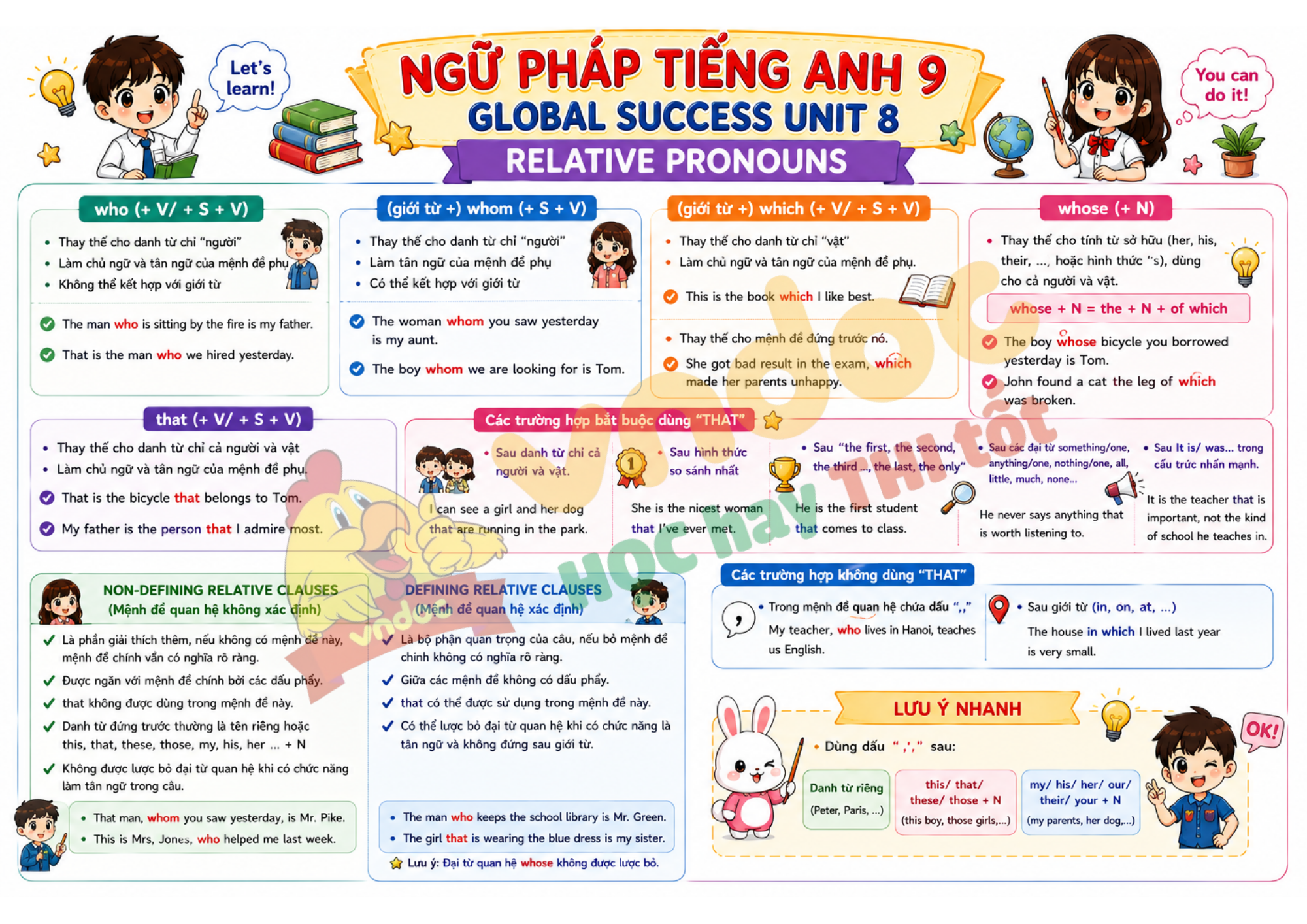
Relative Pronouns
|
who (+ V/ + S + V) |
(giới từ +) whom (+ S + V) |
|
- Thay thế cho danh từ chỉ “người” - Làm chủ ngữ và tân ngữ của mệnh đề phụ - Không thể kết hợp với giới từ The man who is sitting by the fire is my father. That is the man who we hired yesterday. |
- Thay thế cho danh từ chỉ “người” - Làm tân ngữ của mệnh đề phụ - Có thể kết hợp với giới từ The woman whom you saw yesterday is my aunt. The boy whom we are looking for is Tom. |
|
(giới từ +) which (+ V/ + S + V) |
whose (+ N) |
|
- Thay thế cho danh từ chỉ “vật” - Làm chủ ngữ và tân ngữ của mệnh đề phụ. This is the book which I like best. - Thay thế cho mệnh đề đứng trước nó. She got bad result in the exam, which made her parents unhappy. |
- Thay thế cho tính từ sở hữu (her, his, their, ... hoặc hình thức ‘s), dùng cho cả người và vật. whose + N = the + N + of which The boy whose bicycle you borrowed yesterday is Tom. John found a cat the leg of which was broken. |
|
that (+ V/ + S + V) |
|
|
- Thay thế cho danh từ chỉ cả người và vật - Làm chủ ngữ và tân ngữ của mệnh đề phụ. That is the bicycle that belongs to Tom. My father is the person that I admire most. * Các trường hợp bắt buộc dùng “THAT” - Sau danh từ chỉ cả người và vật. I can see a girl and her dog that are running in the park. - Sau hình thức so sánh nhất She is the nicest woman that I've ever met. - Sau “the first, the second, the third ..., the last, the only” He is the first student that comes to class. - Sau các đại từ something/one, anything/one, nothing/one, all, little, much, none... He never says anything that is worth listening to. - Sau It is/ was... trong cấu trúc nhấn mạnh. It is the teacher that is important, not the kind of school he teaches in. * Các trường hợp không dùng “THAT” - Trong mệnh đề quan hệ chứa dấu “,” - Sau giới từ (in, on, at, ...) |
|
|
Non-defining relative clauses |
Defining relative clauses |
||
|
- Là phần giải thích thêm, nếu không có mệnh đề này, mệnh đề chính vẫn có nghĩa rõ ràng. - Được ngăn với mệnh đề chính bởi các dấu phẩy. - that không được dùng trong mệnh đề này. - Danh từ đứng trước thường là tên riêng hoặc this, that, these, those, my, his, her ...+ N - Không được lược bỏ đại từ quan hệ khi có chức năng làm tân ngữ trong câu. That man, whom you saw yesterday, is Mr. Pike. This is Mrs. Jones, who helped me last week. |
- Là bộ phận quan trọng của câu, nếu bỏ mệnh đề chính không có nghĩa rõ ràng. - Giữa các mệnh đề không có dấu phẩy. - that có thể được sử dụng trong mệnh đề này. - Có thể lược bỏ đại từ quan hệ khi có chức năng là tân ngữ và không đứng sau giới từ. The man who keeps the school library is Mr. Green The girl that is wearing the blue dress is my sister. Lưu ý: Đại từ quan hệ whose không được lược bỏ. |
||
|
- Dùng dấu “,”sau |
|||
|
Danh từ riêng (Peter, Paris, ...) |
this/ that/ these/ those + N (this boy, those girls,...) |
my/ his/ her/ our/ their/ your + N (my parents, her dog,...) |
|
Những lỗi sai thường gặp
Dùng which cho người
- Sai: The tourists which visited the museum were from Australia.
- Đúng: The tourists who visited the museum were from Australia.
Dùng who cho vật
- Sai: The hotel who is near the beach is expensive.
- Đúng: The hotel which is near the beach is expensive.
Quên danh từ sau whose
- Sai: The guide whose was very helpful spoke French.
- Đúng: The guide whose advice was very helpful spoke French.
Lặp lại chủ ngữ
- Sai: The guide who he helped us was friendly.
- Đúng: The guide who helped us was friendly.
Nhầm who với whose
- Sai: This is the writer who book I bought.
- Đúng: This is the writer whose book I bought.
Đặt đại từ quan hệ xa danh từ được bổ nghĩa
- Chưa rõ nghĩa: We visited a hotel near the beach which was very luxurious.
- Rõ nghĩa hơn: We visited a luxurious hotel which was near the beach.
Tóm tắt nội dung lý thuyết Unit 8
Bài tập vận dụng
Choose the best second sentence so that it has a similar meaning to the first one.
1. The tourists are from Japan. They are visiting the floating market.
A. The tourists who are visiting the floating market are from Japan.
B. The tourists which are visiting the floating market are from Japan.
C. The tourists whose are visiting the floating market are from Japan.
D. The tourists whom are visiting the floating market are from Japan.
2. This is the hotel. We stayed there last summer.
A. This is the hotel who we stayed there last summer.
B. This is the hotel which we stayed at last summer.
C. This is the hotel whose we stayed at last summer.
D. This is the hotel whom we stayed at last summer.
3. The tour guide's microphone is broken. He is leading our group.
A. The tour guide who is leading our group has a broken microphone.
B. The tour guide whose microphone is broken is leading our group.
C. The tour guide which microphone is broken is leading our group.
D. The tour guide whom microphone is broken is leading our group.
4. The beach is very clean. It attracts many families with children.
A. The beach who attracts many families with children is very clean.
B. The beach whose attracts many families with children is very clean.
C. The beach which attracts many families with children is very clean.
D. The beach whom attracts many families with children is very clean.
5. The travelers missed their flight. They arrived at the airport late.
A. The travelers who arrived at the airport late missed their flight.
B. The travelers which arrived at the airport late missed their flight.
C. The travelers whose arrived at the airport late missed their flight.
D. The travelers whom arrived at the airport late missed their flight.
Tải file để xem trọn bộ File Word và Infographic
Qua phần Ngữ pháp Tiếng Anh 9 Global Success Unit 8 Tourism, học sinh cần phân biệt rõ cách sử dụng who, which và whose. Trong đó, who thay thế cho danh từ chỉ người, which dùng cho sự vật hoặc sự việc, còn whose diễn tả mối quan hệ sở hữu. Các em nên luyện nhận diện danh từ đứng trước, nối hai câu và sửa lỗi sai để sử dụng đại từ quan hệ chính xác trong bài viết cũng như các bài kiểm tra Tiếng Anh lớp 9.