Luyện nghe Tiếng Anh 9 Global Success Unit 4
Luyện nghe tiếng Anh 9 Unit 4
Luyện nghe Tiếng Anh 9 Global Success Unit 4 giúp các em thực hành nghe hiểu theo chủ đề Remembering the Past. Cùng luyện cách theo dõi lời kể và chọn lọc thông tin để hiểu rõ hơn những câu chuyện về quá khứ.
Nội dung tài liệu
- Nội dung: Luyện nghe Tiếng Anh 9 Global Success Unit 4 – Remembering the Past.
- Số lượng: 5 file nghe, mỗi file kèm 1 bài tập, tổng cộng 5 bài tập nghe hiểu.
- Định dạng tài liệu: PDF, Word và Infographic, thuận tiện để in ấn, chỉnh sửa và học trực quan.
- Mục tiêu: Củng cố kỹ năng nghe ý chính, nhận diện thông tin chi tiết và ôn tập kiến thức Unit 4.
- Đối tượng: Học sinh lớp 9 tự luyện nghe và giáo viên cần tài liệu bổ trợ bài học.
Infographic Listening Unit 4
Khám phá bài nghe Unit 4 cùng VnDoc! Sau khi hoàn thành bài tập, hãy thử kể lại nội dung bằng hai hoặc ba câu tiếng Anh để kiểm tra xem em đã nắm được những ý nào.
Nội dung bài nghe Unit 4
Exercise 1
Bài nghe
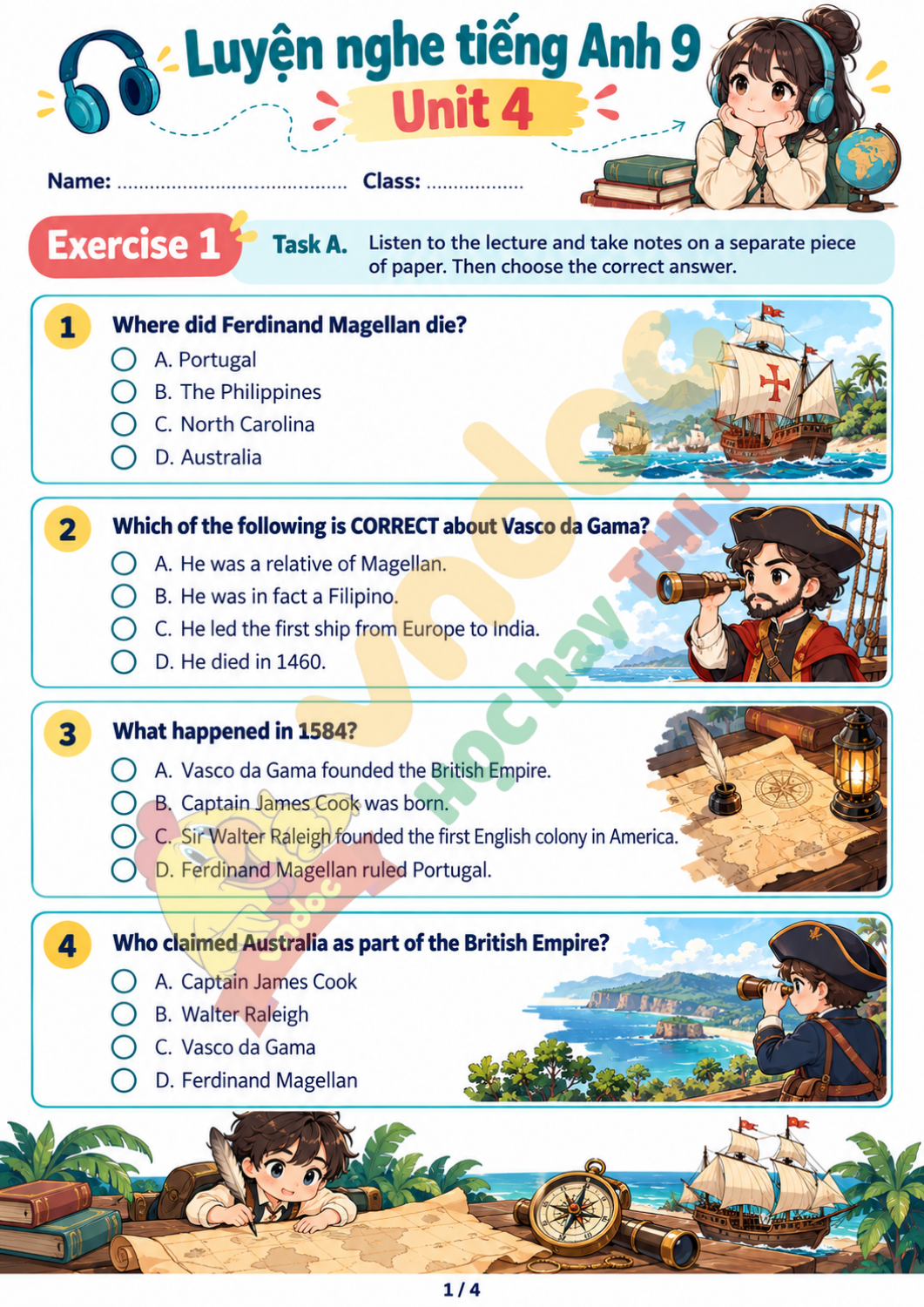
Task A. Listen to the lecture and take notes on a separate piece of paper. Then choose the correct answer.
1. Where did Ferdinand Magellan die?
A. Portugal B. The Philippines
C. North Carolina D. Australia
2. Which of the following is CORRECT about Vasco de Gama?
A. He was a relative of Magellan.
B. He was in fact a Fillipino.
C. He led the first ship from Europe to India.
D. He died in 1460.
3. What happened in 1584?
A. Vasco da Gama founded the British Empire.
B. Captain James Cook was born.
C. Sir Walter Raleigh founded the first English colony in America.
D. Ferdinand Magellan ruled Portugal.
4. Who claimed Australia as part of the British Empire?
A. Captain James Cook B. Walter Raleigh
C. Vasco da Gama D. Ferdinand Magellan
Task B. Listen to the lecture and take notes on a separate piece of paper. Then choose the correct answer.
5. Which of the following was TRUE about the Byzantine Empire?
A. It fell in A.D. 476.
B. It came after the Roman Empire.
C. It was an ancient empire in Egypt.
D. It was a well-known empire in the history.
6. What was the former name of the capital city of Turkey?
A. Constantinople B. Constantine
C. Istanbul D. Ottoman
7. How has the population of Istanbul grown since Constantine’s time?
A. from 10 million to 330 million B. from 476 to 30,000
C. from 30,000 to 10 million D. from 1,453 to 30 million
8. Who moved the capital of the Roman Empire from Rome to Constantinople and when?
A. Emperor Ottoman in 1453
B. the emperor of the Eastern Roman Empire on May 29th
C. Emperor Byzantine in A.D. 476
D. Emperor Constantine in A.D. 330
Exercise 2. Listen to the recording and choose the best answer A, B, C, or D for each question below
Bài nghe
1. What is the speaker's grandmother's age?
A. Over 80 years old
B. Over 70 years old
C. Over 90 years old
D. Over 100 years old
2. What time did the speaker's grandmother use to start her day?
A. 4:00 a.m.
B. 4:30 a.m.
C. 5:00 a.m.
D. 5:30 a.m.
3. What was the speaker's grandmother's hobby?
A. Watching television
B. Reading books
C. Listening to the radio
D. Knitting
4. What did the family use to do in the evenings?
A. Watch movies
B. Play games
C. Go for walks
D. Sit by the fire and talk
5. How did the speaker's grandmother treat illnesses in the family?
A. She took them to the hospital
B. She used herbs she collected
C. She gave them modern medicine
D. She called a doctor
Exercise 3. Listen and decide whether the statements are True (T) or False (F)
Bài nghe
1. Minh’s class is going to visit an old historical site this Saturday.
2. In the past, many families earned a living by working in factories.
3. Children used to help with household chores or take care of younger family members.
4. Lan wishes she could experience life in the past for one day.
5. Minh and Lan believe that learning about the past can help people value and protect their cultural heritage.
Exercise 4: Listen to the following passage about Hanoi in the past and choose the best answer, A, B, C, or D, for each question.
Bài nghe
1. What was the Old Quarter in Ha Noi known for in the past?
A. Large parks
B. Traditional markets
C. Modern skyscrapers
D. Amusement parks
2. How did people in Ha Noi primarily get around in the past?
A. Cars
B. Motorbikes
C. Bicycles
D. Buses
3. Which of the following was a common sight in the streets of Ha Noi?
A. Food trucks
B. Street vendors
C. Tour buses
D. Shopping malls
4. What was a popular pastime for people in Ha Noi?
A. Watching movies
B. Visiting theme parks
C. Walking around the lakes
D. Going to concerts
5. How was the atmosphere in Ha Noi described in the past?
A. Quiet and peaceful
B. Modern and busy
C. Bustling and lively
D. Calm and serene
Exercise 5. Listen to the talk about student life in the past and fill in the blanks with the appropriate words.
Bài nghe
1. In the past, students often had to walk long __________________ to get to school.
2. Classrooms were usually simple, with wooden desks and __________________ blackboards.
3. Instead of digital resources, students relied heavily on __________________ for information.
4. After school, many students helped their families with __________________ tasks.
5. Extracurricular activities were limited, but some students participated in __________________ clubs or sports.
*Tải file để xem đáp án chi tiết*
Mua trọn bộ - Tiết kiệm hơn!
LUYỆN NGHE ĐỀU ĐẶN – TỰ TIN HỌC KÌ 1!
Bộ bài tập luyện nghe tiếng Anh 9 Global Success học kì 1
👉 Đặt mua ngay – Rèn kỹ năng nghe, củng cố kiến thức mỗi ngày!
Câu hỏi thường gặp
Luyện nghe Tiếng Anh 9 Global Success Unit 4 thuộc chủ đề gì?
Unit 4 có chủ đề Remembering the Past – Nhớ về quá khứ. Khi luyện nghe theo chủ đề này, các em nên chú ý những cách diễn đạt về thời gian, kỷ niệm và cuộc sống trước đây.
Nên ôn từ vựng như thế nào trước khi nghe?
Hãy xem lại từ vựng Unit 4 và đọc thành tiếng những từ đã học. Việc kết hợp nghĩa với cách phát âm giúp các em dễ nhận ra từ khi nghe, kể cả khi từ xuất hiện trong một câu dài.
Làm sao để theo kịp bài nghe kể về quá khứ?
Các em có thể ghi nhanh ba thông tin: ai, khi nào và chuyện gì xảy ra. Chú ý các dấu hiệu thời gian để theo dõi diễn biến, tránh nhầm sự việc xảy ra trước với sự việc xảy ra sau.
Có cần hiểu từng từ mới làm được bài nghe không?
Không nhất thiết. Các em nên tập trung vào thông tin câu hỏi yêu cầu và dùng ngữ cảnh để suy đoán phần chưa rõ. Khi ôn lại, hãy chọn những từ thực sự ảnh hưởng đến việc hiểu bài để tra cứu và ghi nhớ.
Luyện nghe Unit 4 là dịp để các em kết nối vốn từ đã học với cách diễn đạt trong lời nói. Hãy nghe lại những đoạn còn khó, ghi chú thông tin quan trọng và tập kể lại ngắn gọn để củng cố cả kỹ năng nghe lẫn khả năng diễn đạt.