Tiếng Anh 12 Bright Workbook Skills Units 3 - 4
Tiếng Anh Bright 12 trang 20
Giải bài tập SBT tiếng Anh 12 Bright Skills Units 3 - 4 trang 36 hướng dẫn giải chi tiết các phần bài tập trong Sách bài tập tiếng Anh lớp 12 Bright Skills Units 3 - 4 giúp các em học sinh chuẩn bị bài tập tại nhà hiệu quả.
1. Read the text. For questions (1-4), choose the best answers (A, B, C or D). Đọc bài khóa. Với các câu hỏi (1-4), chọn đáp án đúng (A, B, C hoặc D).
1. What was the Antikythera mechanism?
A. It was an unusual device.
B. It could predict the weather.
C. It was a common tool of the past.
D. It was a sailor's favourite item.
2. What did scientists discover about it?
A. It was used by divers.
B. It dates from 1901.
C. It was made from bronze and wood.
D. It is over 2000 years old.
3. Why did people call it the 'first computer'?
A. It had scientific dials and a case.
B. There were lots of moving parts.
C. It could make calculations.
D. They had never seen a machine like it.
4. What makes the Antikythera mechanism so special?
A. Archimedes probably made it.
B. No one was able to create similar machines until the 14th century.
C. It was used as a calendar.
D It was very important to predict eclipses.
Đáp án
| 1 - A | 2 - D | 3 - C | 4 - B |
2. Read and complete the dialogue with the phrases/sentences in the list below. Đọc và hoàn thành đoạn hội thoại với các cụm từ/câu trong danh sách dưới đây.
Đáp án
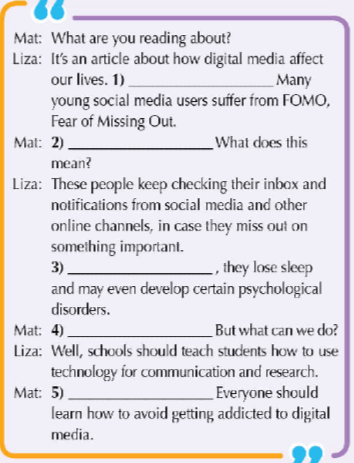
1 - Guess what?
2 - You're joking!
3 - To make matters worse
4 - That's terrible, indeed!
5 - I completely agree.
Hướng dẫn dịch
Mat: Cậu đang đọc gì thế?
Liza: Đó là một bài báo về việc các phương tiện truyền thông kĩ thuật số ảnh hưởng đến cuộc sống của chúng ta như thế nào. Cậu đoán thử xem? Có nhiều người trẻ dùng mạng xã hội đang phải chịu đựng FOMO, sợ bỏ lỡ.
Mat: Cậu đang đùa à! Cái đó nghĩa là gì thế?
Liza: Những người này cứ liên tục kiểm tra hộp thư và thông báo từ mạng xã hội và các kênh trực tuyến khác phòng trường hợp họ bỏ lỡ thứ gì đó quan trọng. Tệ hơn là, họ mất ngủ và có thể mắc một số bệnh rối loạn tâm lí.
Mat: Điều này chắc chắn là tệ rồi! Nhưng chúng ta có thể làm gì?
Liza: Thì, các trường học nên dạy học sinh cách sử dụng công nghệ để giao tiếp và nghiên cứu.
Mat: Mình hoàn toàn đồng ý. Mọi người nên học cách tránh bị nghiện mạng xã hội.
3. Act out dialogues similar to the one in Exercise 2, using the prompts below. Diễn những đoạn hội thoại giống với cái trong Bài tập 2, dùng các gợi ý bên dưới.
• You can get your personal information stolen online./Parents must be strict/Schools must teach students how to avoid online dangers.
• Many users are bullied online./Cyberbullying is a frequent phenomenon./Parents must know who their children chat to online.
• A friend of yours has had his/her identity stolen online./You give him advice.
Đáp án gợi ý
Dialogue 1: Personal information stolen online
Anna: What are you reading about?
Tom: It’s a report about online safety. Guess what? You can easily get your personal information stolen online.
Anna: Seriously? How does that even happen?
Tom: People often share too much or click on unsafe links. To make matters worse, hackers can use that information to access your accounts.
Anna: That sounds really dangerous! But what can we do?
Tom: Well, parents must be strict about their children’s online activities.
Anna: I agree. And schools must teach students how to avoid online dangers. Everyone should learn how to protect themselves.
4. Listen to a person talking about a festival. For questions (1-4), choose the best answers (A, B, C or D). Lắng nghe một người nói về một lễ hội. Với các câu hỏi (1-4), chọn đáp án đúng nhất (A, B, C hoặc D).
Đáp án
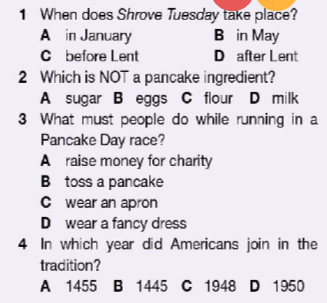
1. C
2. A
3. B
4. D
Nội dung bài nghe
In the UK, there is a festival that takes place on Tuesday every year. Shrove Tuesday is the day before Lent and usually falls in February or March. It is the last opportunity to use up eggs and fats before the fasting period. Pancakes are perfect for this. They are thin, flat cakes made of eggs, milk and flour and fried in a frying pan. That's why Shrove Tuesday is also called Pancake Day. Most people eat them with lemon juice and sugar or fruit and honey and chocolate spread is popular too. Around the country, there are pancake day races in which people run while carrying a frying pan. They sometimes wear an apron or fancy dress. They must toss a pancake in the air and catch it in the pan while running. Spitalfields in London has a popular one and there is even a parliamentary pancake day race. They are good fun but most people use them to raise money for charity. In Olney, Buckinghamshire, they have the oldest race and it's only for women. The tradition started in 1445 when legend says a woman was late for church and ran out of the house holding her frying pan. Whatever the case, the townspeople brought the custom back in 1948 and in 1950, people in the town of Liberal in Kansas USA wanted to start a similar tradition. So now, every year, the two towns compete against each other and compare the speeds of the fastest runners and exchange prizes. It sounds like so much fun. I plan to visit the UK next year on Pancake Day. Who knows? I may even run in a race.
5. Read the report and put the paragraphs in the correct order. Đọc báo cáo và xếp các đoạn văn theo thứ tự đúng.
Đáp án
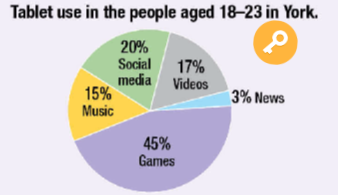
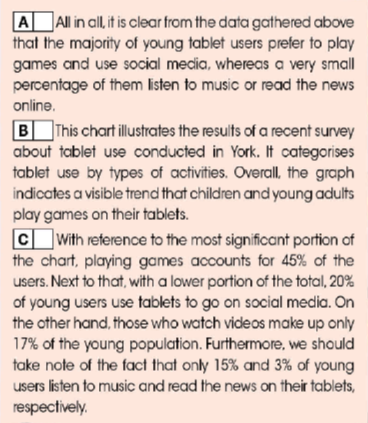
| 1 - B | 2 - C | 3 - A |
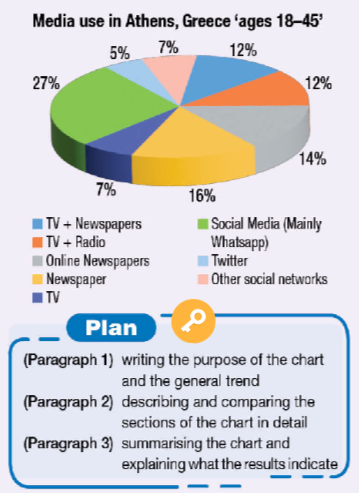
6. Write a report using the information from the pie chart below (about 180-200 words). Viết một báo cáo dùng thông tin trong biểu đồ tròn bên dưới (180 – 200 từ).
Đáp án gợi ý
Report on Media Use in Athens, Greece (Ages 18–45)
The pie chart illustrates how people aged 18 to 45 in Athens, Greece use different types of media. The purpose of the chart is to show which media channels are most and least popular among this age group. Overall, social media—especially WhatsApp—is the most widely used form of media, while traditional newspapers and Twitter are the least preferred.
According to the chart, social media ranks first, accounting for 27% of total media use. It is followed by online newspapers at 16%, indicating a growing preference for digital news sources. Traditional TV and radio remain important, representing 14% and 12% respectively. TV combined with newspapers also accounts for 12%, showing that some users still rely on mixed media for information. Meanwhile, TV alone makes up 7%, suggesting that watching television without other sources is becoming less common.
The least popular forms of media are other social networks (7%), newspapers (5%), and Twitter, which is used by only 2% of the respondents.
In summary, the chart shows a clear shift towards digital platforms, especially social media and online news. The results indicate that younger and middle-aged adults in Athens prefer fast, convenient, and interactive media sources over traditional ones.
Trên đây là Skills Units 3 - 4 tiếng Anh lớp 12 Bright trang 36 đầy đủ nhất.


