Câu đơn và câu ghép tiếng Anh lớp 8
Lý thuyết về Câu đơn và câu ghép tiếng Anh lớp 8
Infographic về Câu đơn & câu ghép lớp 8
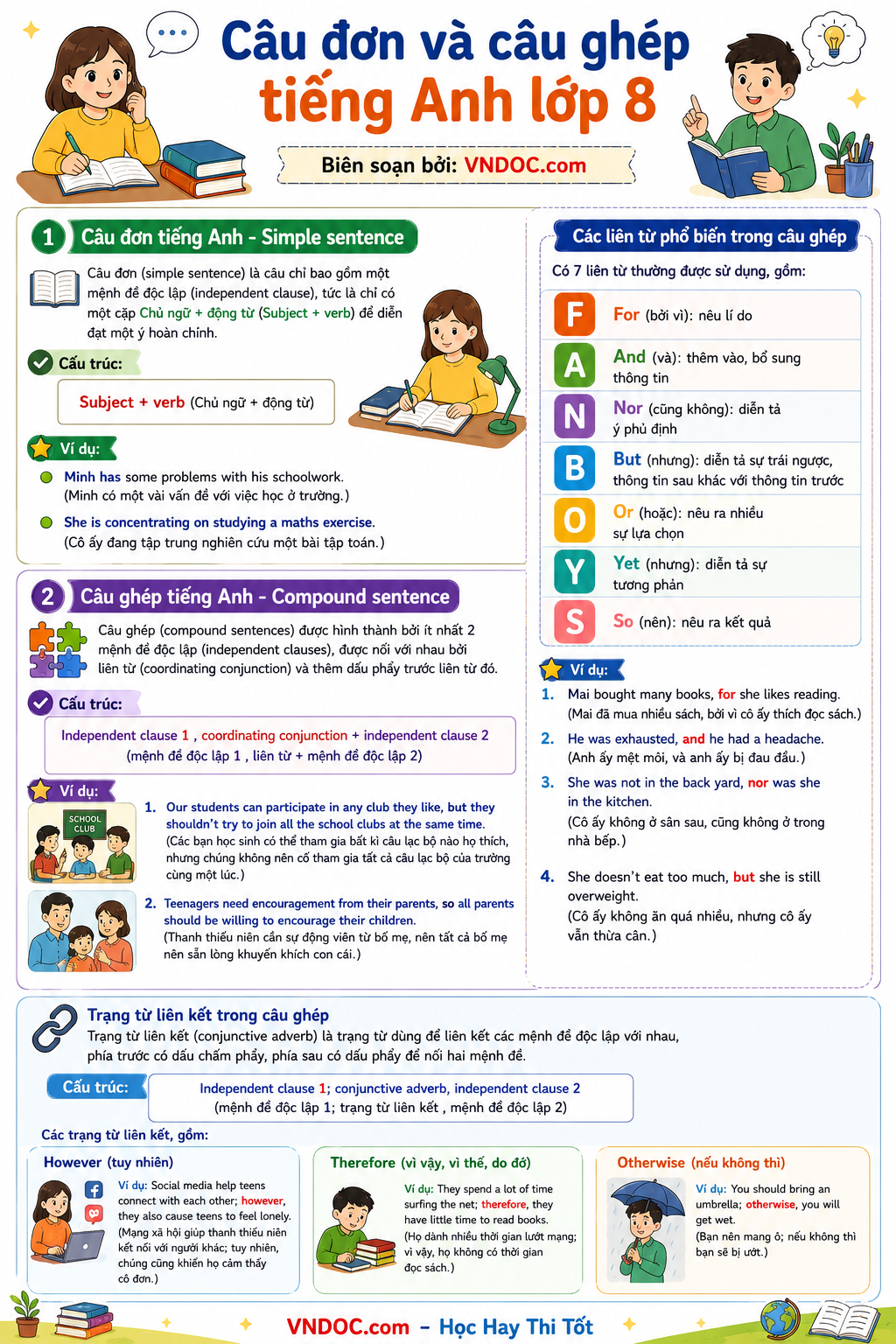
Lý thuyết về câu đơn, câu ghép tiếng Anh 8 nhắc lại cấu trúc câu đơn, câu ghép trong tiếng Anh giúp các em học sinh ôn luyện chủ đề ngữ pháp tiếng Anh cơ bản này hiệu quả.
1. Câu đơn tiếng Anh - Simple sentence
Câu đơn (simple sentence) là câu chỉ bao gồm một mệnh đề độc lập (independent clause), tức là chỉ có một cặp Chủ ngữ + động từ (Subject + verb) để diễn đạt một ý hoàn chỉnh.
Cấu trúc:
Subject + verb (Chủ ngữ + động từ)
Ví dụ:
Minh has some problems with his schoolwork.
(Minh có một vài vấn đề với việc học ở trường.)
She is concentrating on studying a maths exercise.
(Cô ấy đang tập trung nghiên cứu một bài tập toán.)
2. Câu ghép tiếng Anh - Compound sentence
Câu ghép (compound sentences) được hình thành bởi ít nhất 2 mệnh đề độc lập (independent clauses), được nối với nhau bởi liên từ (coordinating conjunction) và thêm dấu phẩy trước liên từ đó.
Cấu trúc:
Independent clause 1 , coordinating conjunction + independent clause 2
(mệnh đề độc lập 1 , liên từ + mệnh đề độc lập 2)
Ví dụ:
1. Our students can participate in any club they like, but they shouldn’t try to join all the school clubs at the same time.
(Các bạn học sinh có thể tham gia bất kì câu lạc bộ nào họ thích, nhưng chúng không nên cố tham gia tất cả câu lạc bộ của trường cùng một lúc.)
2. Teenagers need encouragement from their parents, so all parents should be willing to encourage their children.
(Thanh thiếu niên cần sự động viên từ bố mẹ, nên tất cả bố mẹ nên sẵn lòng khuyến khích con cái. )
Các liên từ phổ biến trong câu ghép
Có 7 liên từ thường được sử dụng, gồm:
- For (bởi vì): nêu lí do
- And (và): thêm vào, bổ sung thông tin
- Nor (cũng không): diễn tả ý phủ định
- But (nhưng): diễn tả sự trái ngược, thông tin sau khác với thông tin trước
- Or (hoặc): nêu ra nhiều sự lựa chọn
- Yet (nhưng): diễn tả sự tương phản
- So (nên): nêu ra kết quả
Để luôn ghi nhớ 7 liên từ này, ta hãy nghĩ đến FANBOYS là các chữ cái đầu của các liên từ này.
Ví dụ:
1. Mai bought many books, for she likes reading.
(Mai đã mua nhiều sách, bởi vì cô ấy thích đọc sách.)
2. He was exhausted, and he had a headache.
(Anh ấy mệt mỏi, và anh ấy bị đau đầu.)
3. She was not in the back yard, nor was she in the kitchen.
(Cô ấy không ở sân sau, cũng không ở trong nhà bếp.)
4. She doesn’t eat too much, but she is still overweight.
(Cô ấy không ăn quá nhiều, nhưng cô ấy vẫn thừa cân.)
Trạng từ liên kết trong câu ghép
Trạng từ liên kết (conjunctive adverb) là trạng từ dùng để liên kết các mệnh đề độc lập với nhau, phía trước có dấu chấm phẩy, phía sau có dấu phẩy để nối hai mệnh đề.
Cấu trúc:
Independent clause 1; conjunctive adverb, independent clause 2
(mệnh đề độc lập 1; trạng từ liên kết , mệnh đề độc lập 2)
Các trạng từ liên kết, gồm:
However (tuy nhiên)
Ví dụ: Social media help teens connect with each other; however, they also cause teens to feel lonely.
(Mạng xã hội giúp thanh thiếu niên kết nối với người khác; tuy nhiên, chúng cũng khiến họ cảm thấy cô đơn.)
Therefore (vì vậy, vì thế, do đó)
Ví dụ: They spend a lot of time surfing the net; therefore, they have little time to read books.
(Họ dành nhiều thời gian lướt mạng; vì vậy, họ không có thời gian đọc sách.)
Otherwise (nếu không thì)
Ví dụ: You should bring an umbrella; otherwise, you will get wet.
(Bạn nên mang ô; nếu không thì bạn sẽ bị ướt.)
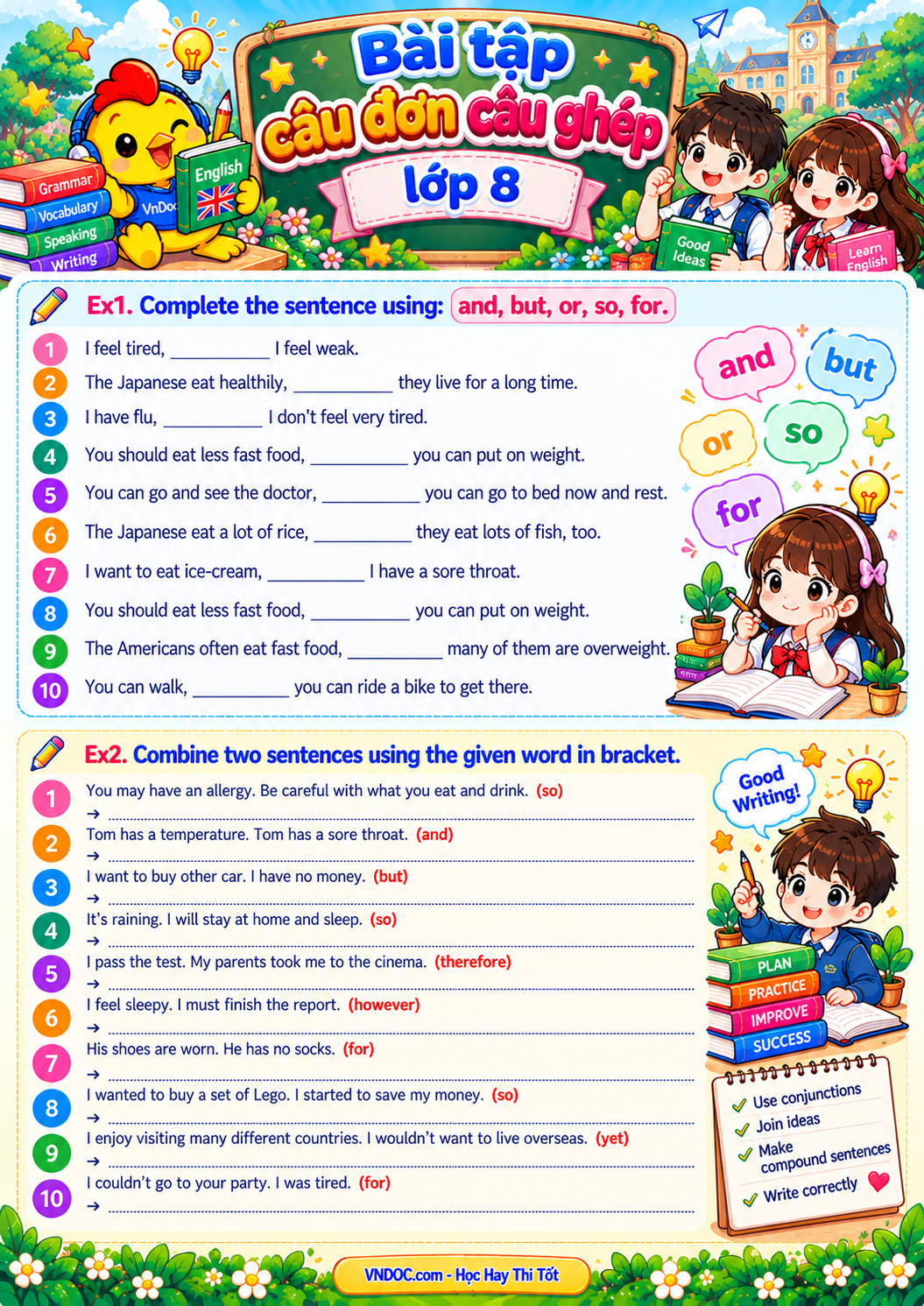
3. Bài tập câu đơn câu ghép lớp 8 có đáp án
Ex1. Complete the sentence using: and, but, or, so, for.
1. I feel tired, _____I feel weak.
2. The Japanese eat healthily, _____they live for a long time.
3. I have flu, _____I don't feel very tired.
4. You should eat less fast food, _____you can put on weight.
5. You can go and see the doctor, _____you can go to bed now and rest.
6. The Japanese eat a lot of rice, _____they eat lots of fish, too.
7. I want to eat ice-cream, _____I have a sore throat
8. You should eat less fast food, _____you can put on weight.
9. The Americans often eat fast food, _____ many of them are overweight.
10. You can walk, _____ you can ride a bike to get there.
Ex2. Combine two sentences using the given word in bracket.
1. You may have an allergy. Be careful with what you eat and drink. (so)
___________________________________________
2. Tom has a temperature. Tom has a sore throat. (and)
___________________________________________
3. I want to buy other car. I have no money. (but)
___________________________________________
4. It’s raining. I will stay at home and sleep. (so)
___________________________________________
5. I pass the test. My parents took me to the cinema. (therefore)
___________________________________________
6. I feel sleepy. I must finish the report. (however)
___________________________________________
7. His shoes are worn. He has no socks. (for)
___________________________________________
8. I wanted to buy a set of Lego. I started to save my money. (so)
___________________________________________
9. I enjoy visiting many different countries. I wouldn’t want to live overseas. (yet)
___________________________________________
10. I couldn’t go to your party. I was tired. (for)
___________________________________________
Ex3. Choose the correct answers.
1. Fred came to school late, for / so / therefore, he overslept.
2. I have finished my work; so / therefore, I and I will go out with you tonight.
3. I was quite busy, but I however, I and I decided to see a movie with James.
4. It was raining heavily; however, I but I for he continued planting trees in the garden.
5. Laura has to finish her housework; however, I otherwise, I therefore, she can’t go out with her friends.
6. We will go to the beach and / so / but enjoy the day.
7. Some students couldn’t go on the class trip to Australia, therefore, / so / but they were very sad.
8. Jane had a broken leg; but / or / however, she tried to take part in the game.
9. I was very sleepy, so I and / but I helped my brother with his homework.
10. You can fly to Ho Chi Minh City, but / or / and you can go there by train.
Ex4. Điền một liên từ thích hợp vào chỗ trống
1. The weather was terrible, _____ we decided to cancel our picnic.
2. You can take the train, _____ you can fly to Da Nang.
3. She studied very hard for the exam, _____ she didn’t pass it.
4. I don't like playing football, _____ does my younger brother.
5. He woke up late this morning, _____ he missed the first bus.
6. The food at that restaurant is delicious, _____ it is quite expensive.
7. Would you like to drink tea, _____ do you prefer coffee?
8. He loves reading books, _____ he spends hours at the library every weekend.
9. My computer is broken, _____ I cannot finish my homework tonight.
10. Lucy is a very talented singer, _____ she is also a brilliant pianist.
Ex5. Choose the correct answer.
1. Which of the following is a simple sentence?
A. I was hungry, so I made a sandwich.
B. My sister likes reading books.
C. It was cold, but we went swimming.
D. He studied hard, and he passed the exam.
2. Which sentence is a compound sentence?
A. The children are playing in the garden.
B. My mother cooks delicious meals.
C. I wanted to go out, but it started raining.
D. She usually walks to school.
3. I was very tired, ______ I went to bed early.
A. but
B. so
C. or
D. yet
4. Nam likes playing football, ______ his brother prefers basketball.
A. but
B. so
C. for
D. or
5. Hurry up, ______ you will miss the bus.
A. and
B. but
C. or
D. so
6. Which conjunction shows a result?
A. But
B. Or
C. So
D. Yet
7. My father ______ my mother work in the same hospital.
A. and
B. but
C. so
D. or
8. It was raining heavily, ______ we decided to stay at home.
A. so
B. but
C. yet
D. or
9. Which sentence contains two independent clauses?
A. Because I was ill.
B. When the bell rang.
C. She opened the door and walked into the room.
D. I called him, but he didn't answer.
10. You can study English online, ______ you can join an English club.
A. but
B. or
C. so
D. yet
Ex6. Identify the sentence type. Viết S (Simple Sentence – câu đơn) hoặc C (Compound Sentence – câu ghép.
1. My best friend lives in a small village. ____
2. I wanted to buy the book, but I didn't have enough money.____
3. The students cleaned the classroom yesterday.____
4. Hoa was sick, so she didn't go to school. ____
5. My father and my mother enjoy gardening. ____
6. You can stay here, or you can come with us. ____
7. The weather was beautiful, and we went on a picnic. ____
8. The little boy ran quickly across the street. ____
9. She practised English every day, yet she wasn't confident. ____
10. My brother likes music and art. ____
ĐÁP ÁN CÓ TRONG FILE TẢI VỀ.
Trên đây là Phân biệt cấu trúc câu đơn & câu ghép tiếng Anh lớp 8.