Tiếng Anh 10 Friends Global Unit 6 6E Word Skills
Tiếng Anh 10 unit 6 6E Word Skills trang 75
Giải tiếng Anh 10 Friends Global unit 6 6E. Word Skills Money bao gồm hướng dẫn giải các phần bài tập tiếng Anh trang 75 giúp các em học sinh dễ dàng chuẩn bị bài tập tiếng Anh tại nhà hiệu quả.
1. Work in pairs. Describe the photo. What do you think the woman is doing? Làm việc theo cặp. Mô tả bức ảnh. Bạn nghĩ người phụ nữ đang làm gì?

Đáp án
She is checking a price on the internet.
2. Read the text. Then answer the questions. Đọc văn bản. Sau đó trả lời các câu hỏi.
1. What is 'showrooming? Have you or someone you know ever showroomed?
2. Do you prefer to buy things in shops or online? Why?
3. Should you expect to pay more for goods in a shop than on a website? Why? /Why not?
4. What would you do if you had to pay to look around a shop?
That'll be $5, please.
A health food shop in Adelaide, Australia, has decided to charge customers S5 for "just looking". The problem is that customers keep coming into the shop and leaving without buying anything. “They pretend to be interested in a product and ask for advice,” says Kate Reeves, the shop owner, "but they usually don't buy anything."
This new phenomenon is called "showrooming". People visit a shop, examine a product, and then buy it online, where it is cheaper. Kate says she spends hours every day talking about products with customers "I can't stand working and not getting paid," she says. 'No one can make me work for free!'
Everyone avoids paying more than they have to, but customers fail to realise that Kate's prices are mostly the same as in larger stores and on websites. They prefer to shop elsewhere as they expect to find the product at a lower price. "If customers choose to buy something, I return the $5 fee," says Kate.
Many shops face the same problem and some may end up introducing a similar charge. The danger is that it asks putting customers off. But Kate in Adelaide says it has made no difference to her business.
Đáp án
1. ‘Showrooming’ is when people visit a shop, examine a product, and then buy it online. Sometimes I showroomed because I just want to take a look at the products but don't want to buy.
2. I prefer buy things online because it saves time and money.
3. No I don't.
4. I would just look and not touch anything.
Hướng dẫn dịch
Nó có giá 5 bảng Anh
Một cửa hàng thực phẩm tốt cho sức khỏe ở Adelaide, Australia, quyết định thu 5 bảng Anh của khác cho việc “chỉ nhìn”. Vấn đề là khách hàng cứ vào tiệm và rời đi mà không mua bất cứ thứ gì. Cô Kate Reeves, chủ cửa hàng, nói rằng “Họ giả vờ hứng thú với một sản phẩm và hỏi lời khuyên, nhưng họ thường không mua gì”.
Hiện tượng này được gọi là “hành vi xem mẫu sản phẩm”. Mọi người ghé một cửa hàng, nghiên cứu một sản phẩm, và họ mua nó trên mạng, nơi mà giá rẻ hơn. Kate nói cô ấy dành hàng giờ mỗi ngày để nói về sản phẩm với khách hàng. “Tôi không thể chịu nổi việc làm việc mà không được trả lương. Không ai có thể bắt tôi làm việc miễn phí được!”
Mọi người tránh việc trả nhiều hơn số tiền họ cần, nhưng khách hàng không nhận ra rằng giá của chỗ Kate hầu như bằng với giá của các cửa hàng lớn và trên các trang web. Họ thích mua sắm ở những chỗ nào mà họ có thể mong đợi sẽ tìm được sản phẩm với giá rẻ hơn. “Nếu khách hàng chọn mua thứ gì đó, tôi sẽ hoàn lại phí 5 bảng Anh”, Kate nói.
Có nhiều cửa hàng phải đối mặt với cùng vấn đề và một vài cửa hàng cuối cùng cũng đã đưa ra mức phí tương tự. Mối nguy hiểm là sẽ làm khách hàng mất hứng. Nhưng Kate cho rằng nó không khiến công việc kinh doanh của cô thay đổi gì.
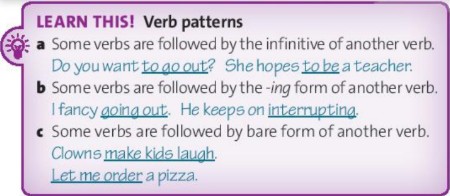
3. Read the Learn this! box. Then find all the verbs in the text in exercise 2 that are followed by the infinitive, bare form or -ing form of another verb. Make three lists in your notebook. Đọc phần Learn this! Sau đó, tìm tất cả các động từ trong bài khóa ở bài tập 2 được theo sau bởi dạng nguyên mẫu có to, nguyên mẫu không to hoặc dạng -ing của một động từ khác. Lập ba danh sách trong sổ tay của bạn.
Đáp án
infinitive: decide, pretend, refuse, fail, prefer, expect, choose
-ing form: keep, spend (time), can’t stand, avoid, end up, risk
bare: form make
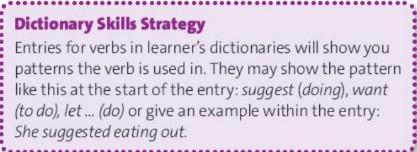
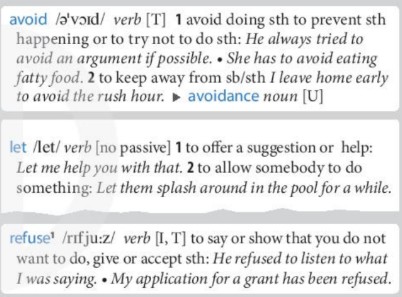
4. Read the Dictionary Skills Strategy and study the dictionary entries below. Which verb a) takes an infinitive, b) takes an -ing form, and c) takes a bare form? Đọc Chiến lược Kỹ năng sử dụng từ điển và nghiên cứu các mục từ điển bên dưới. Động từ nào a) ở dạng nguyên mẫu có to, b) ở dạng Ving, và c) nguyên mẫu không to?
Đáp án
a. refuse
b. avoid
c. let
5. Look up these words in a dictionary and add them to the lists you made in exercise 3. Tra những từ này trong từ điển và thêm chúng vào danh sách bạn đã thực hiện trong bài tập 3
admit (thú nhận); agree (đồng ý); help (giúp đỡ); mind (phiền); offer (cho); promise (hứa)
Đáp án
Infinitive: agree, offer, promise, help
-ing form: admit, mind
bare form: help
6. Complete the sentences. Use the infinitive, bare form or -ing form of the verbs in brackets. Hoàn thành các câu. Sử dụng dạng nguyên mẫu có to, không to hoặc dạng Ving của các động từ trong ngoặc.
1. Jason promised _____ (phone) me.
2. Joe enjoys _____ (shop) in town but refuses _____ (shop) online.
3. Mysister lets me _____ (use) her laptop.
4. Mum offered _____ (give) me a lift to the shops.
5. You can expect _____ (pay) less online than in a shop.
6. Do you fancy _____ (go) to the cinema this evening?
7. Parents do not let children _____ (stay) up late.
8. My mum usually makes me _____ (tidy) up my room.
Đáp án
1. to phone
2. shopping; to shop
3. use
4. to give
5. to pay
6. going
7. stay
8. tidy
7. SPEAKING Work in pairs. Give true information about yourself. Làm việc theo cặp. Cung cấp thông tin trung thực về bản thân.
1. I usually avoid ...
2. I really can't stand ...
3. I don't let ...
4. I spend a lot of time ...
5. I sometimes pretend ...
6. I really want ...
Đáp án
1. I usually avoid eating fast food because it’s unhealthy.
2. I really can’t stand waiting in long lines at the supermarket.
3. I don’t let people use my phone without asking me first.
4. I spend a lot of time reading books and learning English.
5. I sometimes pretend to be busy when I don’t want to talk to someone.
6. I really want to travel abroad one day.
Hướng dẫn dịch
1. Tôi thường tránh ăn đồ ăn nhanh vì nó không tốt cho sức khỏe.
2. Tôi thực sự không chịu nổi việc phải xếp hàng dài ở siêu thị.
3. Tôi không cho người khác dùng điện thoại của mình nếu chưa hỏi ý kiến trước.
4. Tôi dành nhiều thời gian đọc sách và học tiếng Anh.
5. Thỉnh thoảng tôi giả vờ bận khi không muốn nói chuyện với ai đó.
6. Tôi rất muốn được đi du lịch nước ngoài một ngày nào đó.
Trên đây là Soạn tiếng Anh 10 Friends Global 6E Word Skills unit 6 đầy đủ nhất.


