Sách bài tập tiếng Anh 10 unit 8 New ways to learn
SBT tiếng Anh 10 Global Success unit 8 New ways to learn
Giải sách bài tập tiếng Anh lớp 10 Global Success unit 8 hướng dẫn giải đáp án các phần bài tập trong SBT tiếng Anh 10 giúp các em học sinh chuẩn bị bài tập tại nhà hiệu quả.
I. Pronunciation
1. Underline the stressed words in the following sentences. Then mark the stressed syllables in those words. Gạch chân những từ được nhấn mạnh trong các câu sau. Sau đó đánh dấu các âm tiết được nhấn trọng âm trong những từ đó.
Đáp án
1. This 'video is about air pol'lution.
2. We are doing a 'project on edu'cation.
3. This 'way of 'learning is 'really 'interesting.
4. 'Students should 'finish their 'homework before class.
5. 'Online courses are be'coming more and more 'popular.
6. This 'app has 'helped me im'prove my pronunci'ation.
7. Tech'nology has 'brought 'new ex'periences to 'language 'learners.
8. They have bought their 'daughter a 'new 'laptop which can sup'port her 'online 'learning.
II. Vocabulary
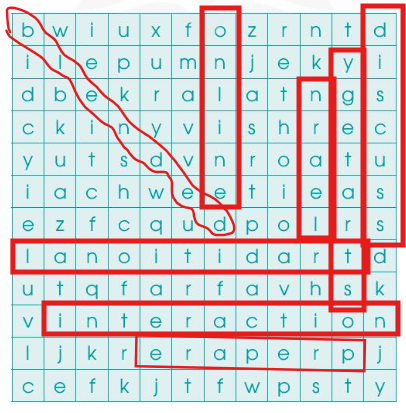
1. Find the following words in the word search. Tìm các từ sau trong phần tìm kiếm từ.
blended online learn discuss
traditional strategy interaction prepare
2. Choose the best answers to complete the following sentences. Chọn câu trả lời đúng nhất để hoàn thành các câu sau.
Đáp án
| 1. B | 2. C | 3. B | 4. A |
| 5. B | 6. B | 7. B | 8. C |
3. Complete the text using the words in the box. Hoàn thành bài văn bằng các từ trong ô trống.
Đáp án
| 1. classroom | 2. classes | 3. face-to-face | 4. connection | 5. assignments |
| 6. discussions | 7. notes | 8. focused | 9. projects | 10. teamwork |
III. Grammar
1. Complete the sentences, using which, that, who or whose. Hoàn thành các câu, sử dụng which, that, who hoặc whose.
1. Smart boards, _______ bring many benefits to students are being used in many schools.
2. This is an electronic device _______ students can use without a lot of training.
3. This school is only for children _______ first language is not English.
4. Students _______ are good at managing time often have better results at school.
5. There are interactive activities _______can be easily downloaded from the Internet.
6. Students _______ don't hand in their papers on time will fail the exam.
7. Teachers _______ computer skills are not good may have a problem with giving online classes.
8. Mr Lan encouraged his students, _______ project was on smart digital books to register in the innovative Idea Competition.
9. Teacher can upload videos and other materials on the classroom blog, _______ can help students understand the lesson.
10. Parents _______ complain about their children's performance may be happy with the new teaching methods.
Đáp án
1. which
2. which/ that
3. whose
4. who/ that
5. which/ that
6. who/ that
7. whose
8. whose
9. which
10. who/ that
2. Use a relative pronoun to combine each pair of sentences. Add commas where necessary. Sử dụng đại từ tương đối để kết hợp từng cặp câu. Thêm dấu phẩy nếu cần.
Đáp án
1. The student who / that sits next to me in the English class is from China.
2. Thank you very much for your email, which was very interesting.
3. Smartphones which have a lot of storage space can store audio books.
4. I talked to the girl whose bicycle broke down in front of the shop.
5. What did you do with the money that / which your mother gave you?
6. We really love participating in discussions which helps us share our ideas and learn from others.
7. The children who / that were playing in the playground are not from our school.
8. My classmate, whose father is a musician, has won the 1st prize in the singing competition.
9. Science teachers who / that use 3D projectors and other devices can easily explain the topics.
10. Mr Minh has created a list of the most useful apps for his classrooms, which is available on his blog.
3. There is a mistake in each sentence. Find and correct it. Có một sai lầm trong mỗi câu. Tìm và sửa nó.
1. The man works for a company who makes good laptops and tablets.
2. Do you remember the number of activities what we did in class today?
3. What is the name of the girl her mother is a famous actress?
4. An e-book is an electronic book which can read on a mobile device.
5. Nam, that didn't take any extra class got the highest score in the maths exam.
6. A computer technician whom served us was very nice.
Đáp án
1 - who sửa thành which/ that
2 - what sửa thành which/ that
3 - her sửa thành whose
4 - can read sửa thành can be read
5 - that sửa thành who
6 - whom sửa thành who/ that
IV. Reading
1. Read the text and choose the best answers. Đọc văn bản và chọn câu trả lời đúng nhất.
You often (1)________ across new words when you read something in a foreign language. You may guess or check the (2) ________ of these words in a dictionary. The level of accuracy that you require and your available time decide your (3) ________. If you are someone who frequently uses the dictionary, you should remember that every dictionary has its (4) ________. Each definition has a limited meaning and you can fully understand a word only after you meet it in a (5) ________ of contexts. You should also be aware of the risk of using dictionaries that translate meanings from English into your native language and vice versa. So, it is usually much safer to (6) ________ in an Engish-English dictionary. Moreover, you are not allowed to use a dictionary in most exams. (7) ________ you are allowed to use one, looking up new words is quite time-consuming while exams are always timed. (8) ________, it is better to the meanings of unfamiliar words.
Đáp án
1. C 2. B 3. D 4. C 5. A 6. B 7. D 8. B
2. Read the text and choose the best answers to complete the sentences. Đọc văn bản và chọn câu trả lời đúng nhất để hoàn thành các câu.
1. The project of Etalk has helped children in Malawi make an improvement in ________.
A. language
B. maths
C. software
2. “Onebillion” gets its names from the number of children ________.
A. who have participated in the project up to now
B. who are currently participating in the project
C. that the project expects to participate
3. There is a lot of pressure on the education system in Malawi because of ________.
A. fewer teachers
B. the lack of teaching resources
C. the increase in student numbers
4. Giving girls some basic skills at primary schools means ________.
A. they will have fewer but healthier children
B. they are less likely to find jobs
C. they have better health and more children
5. In the Onebillion project, a class consists of ________.
A. over 50 students
B. about 25 to 50 students
C. less than 25 students
6. The children in Oneclass ________.
A. study in their normal classroom
B. work for 30 minutes every day
C. are guided by an online teacher
7. This learning app gives children in Malawi an opportunity to ________.
A. manage their study time
B. speed up the learning process
C. meet an online teacher
Đáp án
1. B 2. C 3. C 4. A 5. B 6. C 7. A
V. Speaking
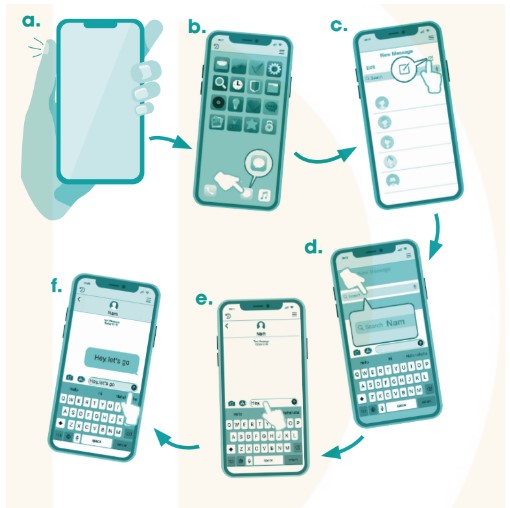
1. Match the following instructions with suitable pictures. Then use First, Next, Then, After that, Finally to give complete instructions about how to send texts with a smartphone. Ghép các hướng dẫn sau với hình ảnh phù hợp. Sau đó, sử dụng Đầu tiên, Tiếp theo, Sau đó, Sau đó, Cuối cùng để cung cấp hướng dẫn đầy đủ về cách gửi tin nhắn văn bản bằng điện thoại thông minh.
1. Tap the 'New message' button.
2. Send your message.
3. Turn on your smartphone.
4. Type your message in the field near the middle of the screen.
5. Find the message icon on the screen and tap it.
6. Type the name or number of the person you want to text.
Đáp án
1 - c
2 - f
3 - a
4 - e
5 - b
6 - d
First, turn on your smartphone.
Next, find the message icon on the screen and tap it.
Then, tap the “New message” button.
After that, type the name or number of the person you want to text and type your message in the field near the middle of the screen.
Finally, send your message.
2. Prepare a short talk about the benefits of face-to-face learning using the ideas in the box. You can start the talk with the sentence below. Chuẩn bị một cuộc nói chuyện ngắn về lợi ích của việc học trực tiếp bằng cách sử dụng các ý tưởng trong hộp. Bạn có thể bắt đầu bài nói bằng câu dưới đây.
- Interact with teachers and classmates face to face
- connect with other students and help solve problems more quickly
- have fewer distractions in class than at home
Face-to-face learning has some benefits. ...
Đáp án gợi ý
Face-to-face learning has some benefits. First, students can interact with teachers and classmates directly, which helps them understand lessons more clearly. They can ask questions and receive immediate answers in class. In addition, students can easily connect with other students and work together to solve problems more quickly. Group discussions also become more effective. Moreover, learning in a classroom has fewer distractions than studying at home, where students may be disturbed by phones or TV. Therefore, face-to-face learning creates a better environment for concentration and effective learning.
Hướng dẫn dịch
Học trực tiếp có một số lợi ích. Thứ nhất, học sinh có thể tương tác trực tiếp với giáo viên và bạn bè, giúp họ hiểu bài rõ hơn. Họ có thể đặt câu hỏi và nhận được câu trả lời ngay lập tức trong lớp. Ngoài ra, học sinh có thể dễ dàng kết nối với các bạn khác và cùng nhau giải quyết vấn đề nhanh hơn. Thảo luận nhóm cũng trở nên hiệu quả hơn. Hơn nữa, học tập trong lớp ít bị phân tâm hơn so với học ở nhà, nơi học sinh có thể bị làm phiền bởi điện thoại hoặc tivi. Do đó, học trực tiếp tạo ra môi trường tốt hơn cho sự tập trung và học tập hiệu quả.
>> Xem thêm nhiều bài viết hay tại: Talk about the benefits of face-to-face learning using the ideas in the box
VI. Writing
1. Complete the second sentence so that it has a similar meaning to the first one using the word in brackets. Use between two and five words. Hoàn thành câu thứ hai sao cho nó có nghĩa tương tự với câu đầu tiên bằng cách sử dụng từ trong ngoặc. Sử dụng từ hai đến năm từ.
1.Why don't you watch the videos uploaded into the homework folder before class? (WATCHING)
How about ____________ into the homework folder before class?
2.Her parents won't let her bring her iPad to school. (ALLOWED)
She won't ____________ her iPad to school.
3.I don't believe this is the best school in the city! (SCHOOLS)
There must ____________ one in the city.
4.It was his grandfather who taught him to read music. (WAS)
He ____________ by his grandfather.
5.Students must pay the fees before this online course begins. (FULL)
The fees ____________ before this online course begins.
6.The teacher had to find out whose papers they were. (BELONGED)
The teacher had to find out ____________ to.
7.A friend told us about Eclass. (WERE)
We ____________ by a friend.
8.It is wrong to copy the homework from your friend. (SHOULD)
You ____________ the homework from your friend.
9.Students will complete more projects and group assignments in the future. (COMPLETED)
More projects and group assignments ____________ in the future.
10.The teacher is satisfied with our presentations on global warming. (HAPPY)
The teacher ____________ our presentations on global warming.
Đáp án
1. How about watching the videos uploaded into the homework folder before class?
2. She won't be allowed to bring her iPad to school.
3. There must be better schools than this one in the city.
4. He was taught to read music by his grandfather.
5. The fees must be paid in full before this online course begins.
6. The teacher had to find out who the papers belonged to.
7. We were told about Eclass by a friend.
8. You shouldn't / should not copy the homework from your friend.
9. More projects and group assignments will be completed by students in the future.
10. The teacher is happy with our presentations on global warming.
2. Rearrange the words to make complete sentences. Sắp xếp lại các từ để tạo thành câu hoàn chỉnh.
1. the / teachers / of /mobile/devices/have/ Many / benefits/ understood /.
2. learning / devices / size, / different / Mobile/in/functions / are/ weight, / and/.
3. who / can / Small / needs / special / this / children / of / new / application / have / advantage / take /.
4. you / do/ listening / smartphone / How / with / practise / your /?
5. download /store / laptop / in / Students / and/ later / can /use / information /it/
their / for /.
6. classroom/more/ students / over / gives / Flipped / study / their / control/.
Đáp án
1. Many teachers have understood the benefits of mobile devices.
2. Mobile learning devices are different in size, weight and functions.
3. Small children who have special needs can take advantage of this new application.
4. How do you practise listening with your smartphone?
5. Students can download information and store it in their laptop for later use.
6. Flipped classroom gives students more control over their study.
3. Write a paragraph (120-150 words) about the disadvantages of using electronic devices in studying. You may use the suggested ideas below. Viết đoạn văn (120-150 chữ) nói về nhược điểm của việc sử dụng thiết bị điện tử trong học tập. Bạn có thể sử dụng các ý tưởng được đề xuất bên dưới.
- slow Internet connection; always relies on the Internet or Wi-Fi
- easily distracted by online entertainment programmes
- technical problems and viruses
Đáp án gợi ý
Using electronic devices in studying has several disadvantages. First, students often rely too much on the Internet or Wi-Fi to do their homework and research. When the Internet connection is slow or unstable, studying can be interrupted and become ineffective. Second, electronic devices easily distract students because of online entertainment programmes such as games, social media, and videos. Instead of focusing on lessons, students may waste time chatting or watching short clips. Finally, technical problems are another serious drawback. Devices can suddenly break down, run out of battery, or be infected by viruses, causing students to lose important data and assignments. Therefore, although electronic devices are useful, students should use them wisely to avoid these disadvantages.
Hướng dẫn dịch
Việc sử dụng thiết bị điện tử trong học tập có một số nhược điểm. Thứ nhất, sinh viên thường phụ thuộc quá nhiều vào Internet hoặc Wi-Fi để làm bài tập về nhà và nghiên cứu. Khi kết nối Internet chậm hoặc không ổn định, việc học tập có thể bị gián đoạn và trở nên kém hiệu quả. Thứ hai, thiết bị điện tử dễ làm sinh viên xao nhãng bởi các chương trình giải trí trực tuyến như trò chơi, mạng xã hội và video. Thay vì tập trung vào bài học, sinh viên có thể lãng phí thời gian trò chuyện hoặc xem các đoạn video ngắn. Cuối cùng, các vấn đề kỹ thuật là một nhược điểm nghiêm trọng khác. Thiết bị có thể đột ngột bị hỏng, hết pin hoặc bị nhiễm virus, khiến sinh viên mất dữ liệu và bài tập quan trọng. Do đó, mặc dù thiết bị điện tử rất hữu ích, sinh viên nên sử dụng chúng một cách khôn ngoan để tránh những nhược điểm này.
>> Xem thêm nhiều bài viết tại: Nhược điểm của việc sử dụng thiết bị điện tử trong học tập bằng tiếng Anh lớp 10
Advantages or disadvantages of using electronic devices in learning
Trên đây là Giải bài tập SBT tiếng Anh Unit 8 lớp 10 Global Success.


