Tiếng Anh 11 Friends Global Unit 7 7I Culture
Giải Tiếng Anh 11 Friends Global Unit 7 trang 94
Giải bài tập SGK tiếng Anh 11 Friends Global Unit 7 7I Culture trang 94 hướng dẫn giải chi tiết các phần bài tập trong Sách giáo khoa tiếng Anh lớp 11 Friends Global giúp các em học sinh chuẩn bị bài tập tại nhà hiệu quả.
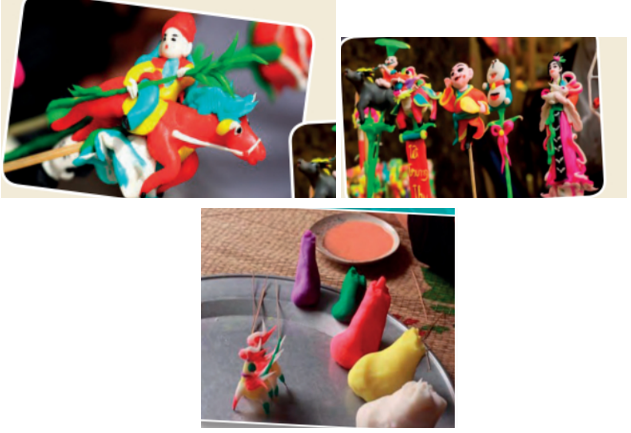
1. SPEAKING Look at the photos. Do you know what this art form is? Did you use to have any toy of this kind?
(Nhìn vào những bức ảnh. Bạn có biết loại hình nghệ thuật này là gì không? Bạn đã từng sở hữu món đồ chơi nào như thế này chưa?)
Gợi ý đáp án
The pictures show tò he, which is a traditional Vietnamese art form of sculpting edible figurines made from glutinous rice powder. These figurines can be shaped into various forms such as animals, fruits, and flowers, and are often brightly colored.
I usually bought to he at the fairs near my house when I was a child.
(Các bức tranh cho thấy tò he, một loại hình nghệ thuật điêu khắc tượng nhỏ ăn được truyền thống của Việt Nam làm từ bột gạo nếp. Những bức tượng nhỏ này có thể được tạo hình thành nhiều dạng khác nhau như động vật, trái cây và hoa và thường có màu sắc rực rỡ.
Tôi thường mua tò he ở phiên chợ gần nhà khi tôi còn nhỏ.)
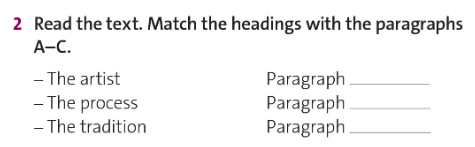
2. Read the text. Match the headings with the paragraphs A-C.
(Đọc văn bản. Nối các tiêu đề với các đoạn A-C.)
Bài nghe
Gợi ý đáp án
The artist - Paragrahph B
The process - Paragraph A
The tradition - Paragraph C
Lời giải chi tiết
- The artist
(Nghệ nhân)
Thông tin: “To he can be made by anyone who is creative and skillful enough, so parents can become favourite to he artists of their children.”
(Bất cứ ai đủ sáng tạo và khéo léo đều có thể làm được, vì vậy cha mẹ có thể trở thành nghệ nhân tò he của con cái họ.)
=> Paragraph B
- The process
(Quy trình)
Thông tin: “The dough can be made from flour taken from ground rice or sticky rice, but the amount of sticky rice should be restricted to just 10 percent of the dough. Besides making nice dough, the artist prepares natural colours, which are usually made from leaves, vegetables or fruits.”
(Bột có thể được làm từ bột lấy từ gạo xay hoặc gạo nếp, nhưng lượng gạo nếp chỉ nên giới hạn ở mức 10% của bột. Bên cạnh việc nhào bột đẹp, nghệ nhân còn pha màu tự nhiên, thường được làm từ lá, rau hoặc trái cây.)
=> Paragraph A
- The tradition
(Truyền thống)
Thông tin: “Xuan La village in Ha Noi is famous for this traditional art. Devoted artists have brought this beautiful art to everywhere in Viet Nam.”
(Làng Xuân La ở Hà Nội nổi tiếng với nghệ thuật truyền thống này. Những nghệ nhân tận tụy đã mang nghệ thuật tuyệt đẹp này đến mọi nơi trên đất nước Việt Nam.)
=> Paragraph C
3. Read the text again and write True or False to the statements 1-5.
(Đọc văn bản một lần nữa và viết Đúng hoặc Sai cho các câu 1-5.)
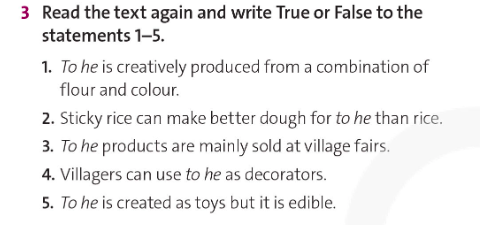
Gợi ý đáp án
|
1. T |
2. F |
3. F |
4. T |
5. T |
4. Put the following sentences A-C into the correct gaps 1-3. Then listen and check.
(Đặt các câu A-C sau vào chỗ trống đúng 1-3. Sau đó nghe và kiểm tra.)
Bài nghe
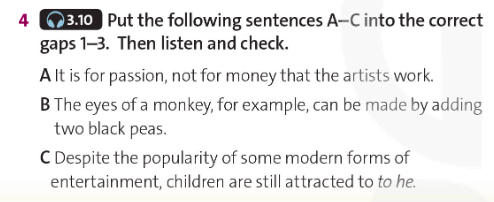
Gợi ý đáp án
|
1. B |
2. A |
3. C |
Nội dung bài nghe
Many of children’ s toys are perfect craftwork. To he, Vietnamese folk art, is a typical example.
A: To he is made from dough into different little things or animals which Vietnamese children love to keep as toys. Interesting shapes can be created to the wish of the children. It could be an animal like a chicken, a monkey or some fruits like a hand of bananas. The dough can be made from flour taken from ground rice or sticky rice, but the amount of sticky rice should be restricted to just 10 percent of the dough. Besides making nice dough, the artist prepares natural colours, which are usually made from leaves, vegetables or fruits. Sometimes paint is used, but traditionally natural items are preferred because they will make safe edible toys. The artist may creatively use leaves or small twigs to make further decorations. The eyes of a monkey, for example, can be made by adding two black peas.
B: To he can be made by anyone who is creative and skillful enough, so parents can become favourite to he artists of their children. However, great artists of to he can be found in many Vietnamese villages. They can make extraordinary artworks with beautiful shapes, harmonious combination of colours, and lifelike features. The artists usually travel through villages or come to local fairs and festivals selling toys to children and their artworks play an important role in folk decorations. It is for passion, not for money that the artists work.
C: Nobody knows exactly when to he came into being, but it is believed to come from the north of Viet Nam. Xuan La village in Ha Noi is famous for this traditional art. Devoted artists have brought this beautiful art to everywhere in Viet Nam. Outside a school gate or on the pavement of a crowded street, a to he artist can be found passionately creating little colourful toys for some young children. Despite the popularity of some modern forms of entertainment, children are still attracted to to he. To he remains an interesting feature of Vietnamese culture.
5. Match the highlighted words in the text with the following words or phrases.
(Nối các từ được đánh dấu trong văn bản với các từ hoặc cụm từ sau.)
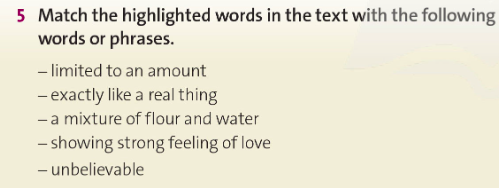
Gợi ý đáp án
- limited to an amount = restricted
- exactly like a real thing = lifelike
- a mixture of flour and water = dough
- showing strong feeling of love = passionately
- unbelievable = extraordinary
6. SPEAKING Work in groups. Discuss the question.
(Làm việc nhóm. Thảo luận câu hỏi.)
What are the benefits which children's traditional games like to he can bring about?
(Những trò chơi truyền thống của trẻ em như tò he có thể mang lại những lợi ích gì?)
Gợi ý đáp án
Traditional games like to he can bring numerous benefits to children. First and foremost, they encourage creativity and imagination as children learn to shape the dough into various figures and animals. This helps develop fine motor skills and hand-eye coordination as well. Additionally, traditional games provide a way for children to connect with their cultural heritage and learn about the history and traditions of their community. Playing these games can also promote socialization as children learn to share and work together to create their to he figurines. Finally, traditional games like to he offer a break from screens and technology, allowing children to engage in physical and tactile activities that promote mindfulness and relaxation.
Trên đây là Unit 7 tiếng Anh lớp 11 Friends Global trang 94 đầy đủ nhất.


