Tiếng Anh 12 Bright Unit 4 4c Listening
Giải tiếng Anh 12 Bright unit 4 4c. Listening trang 48
Giải SGK tiếng Anh Bright 12 unit 4 Cultural diversity 4c Listening bao gồm đáp án chi tiết các phần câu hỏi trong student book Anh 12 Bright giúp các em học sinh dễ dàng chuẩn bị bài tập tại nhà hiệu quả.
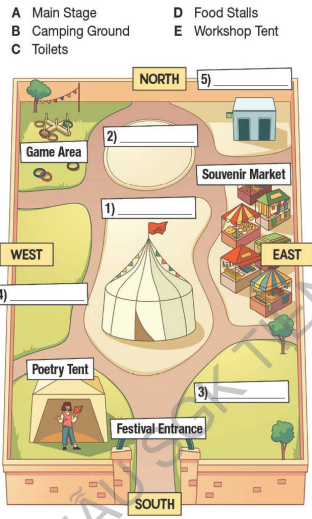
1. You are going to listen to an organiser giving directions around a festival site. Look at the map. Label the places (1-5) with the letters (A-E). Bạn sẽ nghe một người tổ chức chỉ đường xung quanh một khu vực lễ hội. Nhìn vào bản đồ. Dãn nhán các vị trí (1-5) với các chữ cái (A-E).
2. You are going to listen to a commentator talking about coming-of-age traditions. Read the questions and answer choices. Which of the answer choices do you think will be the right ones? Bạn sẽ nghe một người thuyết minh nói về lễ trưởng thành. Đọc các câu hỏi và các lựa chọn. Lựa chọn nào bạn nghĩ sẽ đúng?
1. What does the speaker say about 16-year-olds in the USA?
A. They are permitted to have a full-time job.
B. They are not allowed to drive by law.
C. They don't consider themselves adults.
D. They always receive a car as a birthday gift.
2. What is NOT true about Seijin no Hi in Japan?
A. It is a time when people wear traditional clothing.
B. It is for people who turned twenty the previous year.
C. It takes place on the second of January every year.
D. It includes a special ceremony for twenty-year-olds.
3. What is TRUE about the Inuit tradition of North Baffin Island?
A. It is a less difficult experience than other coming-of-age traditions.
B. It always takes place when all the boys turn 11.
C. It is intended to help boys grow closer to their fathers.
D. It exists so that boys can learn to look after themselves.
3. Listen to the talk. For questions (1-3), choose the best answers (A, B, C or D). Lắng nghe bài nói. Với câu hỏi (1-3), chọn đáp án đúng nhất (A, B, C hoặc D).
Đáp án
1. A
2. C
3. D
Nội dung bài nghe
Reaching adulthood is an important part of every person's life, and that's why coming of age traditions exist. Interestingly, these traditions vary significantly culture by culture.
In the USA, it is common to celebrate turning 16 years old. This is when American teens gain more freedom as they can legally drive and have a full-time job. To celebrate their adulthood, they have a sweet 16-party. This is usually a large formal occasion with music and dancing. There are gifts too, and some parents even give their son or daughter a car as a present.
In Japan, people celebrate Seijin no Hi, or Adult's Day, on the second Monday of January every year. This is a public holiday for all of the young people who turned 20 the year before. Twenty-year-olds across Japan wear formal, traditional outfits and attend a special ceremony in their local community. Afterwards, they have a meal with family and friends, and celebrate becoming legal adults in Japan.
The Inuit people of North Bath in Ireland in the Arctic have a more challenging tradition. At the age of 11 or 12, boys must go and spend time in the wild with their fathers. There they learn about the environment and local wildlife, and develop the skills they need to survive. This tradition exists to teach boys how to survive by themselves. The Inuit people believe this is a major part of being an adult. Every culture has its own coming of age traditions. What traditions exist in your culture?
Trên đây là Giải SGK Anh 12 Bright unit 4 Cultural diversity 4c Listening trang 48.


