Tiếng Anh 11 Global Success Unit 10 Reading
Tiếng Anh 11 trang 113
Nằm trong bộ tài liệu Giải tiếng Anh 11 Kết nối tri thức theo từng Unit, Soạn tiếng Anh 11 Unit 10 Reading giúp các em chuẩn bị bài tập SGK tiếng Anh hiệu quả.
U Minh Thuong - A unique national park
(U Minh Thượng – Vườn quốc gia độc đáo)
1. Work in pairs. Look at the photos and discuss the questions.
(Làm việc theo cặp. Nhìn vào các bức ảnh và thảo luận các câu hỏi.)
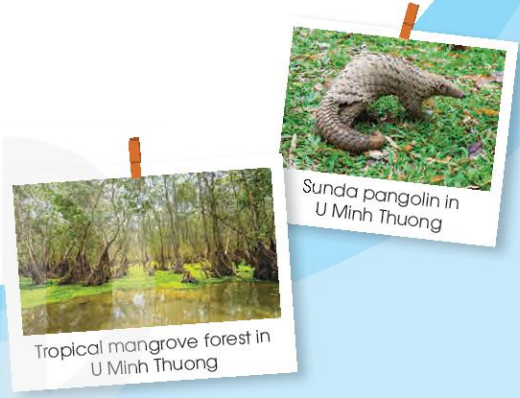
Gợi ý đáp án
A: Have you ever been to U Minh Thuong National Park? Where is it?
(Bạn đã bao giờ đến Vườn quốc gia U Minh Thượng chưa? Nó ở đâu?)
B: No, I haven't. Where is it located?
(Không, tôi không có. Nó nằm ở đâu?)
A: It's located in the southern part of Vietnam, in the Mekong Delta region.
(Nó nằm ở phía nam của Việt Nam, trong khu vực đồng bằng sông Cửu Long.)
B: Ah, I see. What can/did you see in the park?
(À, tôi hiểu rồi. Bạn có thể/đã nhìn thấy gì trong công viên?)
A: Well, I've seen some rare animals like otters and pangolins, and also many types of birds. The park is famous for its diverse ecosystems, including mangrove forests and wetlands.
(Chà, tôi đã thấy một số loài động vật quý hiếm như rái cá và tê tê, và cũng có nhiều loại chim. Công viên nổi tiếng với hệ sinh thái đa dạng, bao gồm rừng ngập mặn và vùng đất ngập nước.)
B: That sounds really interesting. I would love to visit the park someday and see those animals and ecosystems.
(Điều đó nghe thật thú vị. Tôi rất thích đến thăm công viên vào một ngày nào đó và xem những loài động vật và hệ sinh thái đó.)
2. Read the article and match the headings (1-4) to the paragraphs (A-D).
(Đọc bài viết và nối các tiêu đề (1-4) với các đoạn văn (A-D).)
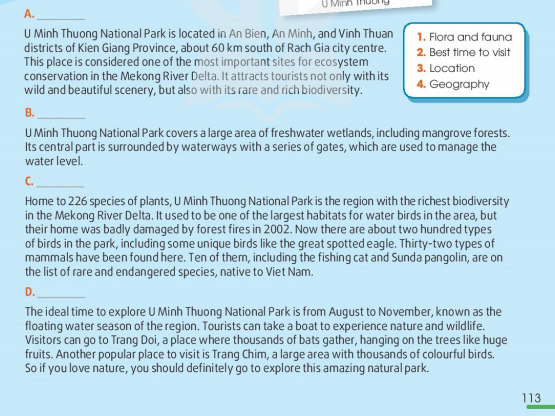
Gợi ý đáp án
|
A. 3 |
B. 4 |
C. 1 |
D. 2 |
3. Read the article again and complete each sentence with no more than THREE words.
(Đọc lại bài viết và hoàn thành mỗi câu với không quá BA từ.)
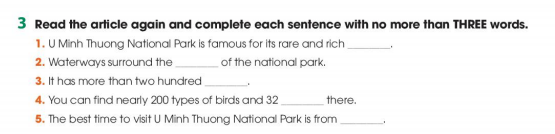
Gợi ý đáp án
|
1. biodiversity |
2. central part |
3. species of plants |
4. types of mammals |
5. August to November |
Lời giải chi tiết
1. U Minh Thuong National Park is famous for its rare and rich biodiversity.
(Vườn quốc gia U Minh Thượng nổi tiếng với sự đa dạng sinh học quý hiếm và phong phú.)
2. Waterways surround the central part of the national park.
(Các tuyến đường thủy bao quanh khu vực trung tâm của vườn quốc gia.)
3. It has more than two hundred species.
(Nó có hơn hai trăm loài.)
4. You can find nearly 200 types of birds and 32 mammals there.
(Bạn có thể tìm thấy gần 200 loại chim và 32 loài động vật có vú ở đó.)
5. The best time to visit U Minh Thuong National Park is from August to November.
(Thời gian tốt nhất để tham quan Vườn quốc gia U Minh Thượng là từ tháng 8 đến tháng 11.)
4. Work in groups. Discuss the following questions.
(Làm việc nhóm. Thảo luận các câu hỏi sau.)
Why do we need national parks? What should we do to protect them?
(Tại sao chúng ta cần công viên quốc gia? Chúng ta cần làm gì để bảo vệ chúng?)
Gợi ý đáp án
National Parks protect wildlife, habitats, and nature from destruction and human impact. They give animals a safe space to breed and survive. Over 247 species of threatened or endangered plants and animals are protected in National Parks. National parks protect places of natural beauty. National park is home to many endemic species. They also protect places important to Aboriginal people, and places that show how people lived in the past. National parks are actually protected areas. They protect many amazing animals and landscapes, such as the world's largest living things, Giant Sequoia trees, the longest cave system known to the world, Mammoth Cave National Park, and Crater Lake, America’s deepest lake etc.
To protect national parks, some actions that can be taken include:
Raising awareness: People need to understand the importance of national parks and the impact that their actions can have on them.
Limiting human impact: National parks should be managed in a way that minimizes the impact of human activities such as logging, mining, and construction.
Enforcing regulations: Rules and regulations should be in place to protect the parks, and these rules should be enforced to prevent illegal activities.
Supporting park staff: Adequate resources should be provided to national parks and their staff to ensure that they can effectively manage and protect the parks.
Educating visitors: Visitors should be educated about how to behave responsibly in national parks, such as avoiding littering, staying on marked trails, and not disturbing wildlife.
Trên đây là Soạn tiếng Anh 11 Global Success Unit 10 Reading đầy đủ nhất.


