Tiếng Anh 12 Unit 8 Listening Global Success
Tiếng Anh 12 Unit 8 Listening trang 106 107 Global Success
Giải SGK tiếng Anh 12 Global Success unit 8 Listening trang 106 107 hướng dẫn giải chi tiết bài tập tiếng Anh unit 8 Listening giúp các em chuẩn bị bài tập tiếng Anh hiệu quả.
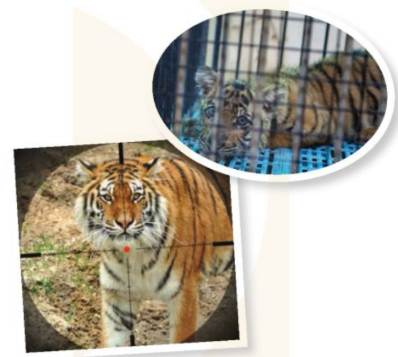
1. Work in pairs. Look at the pictures and discuss the following questions. Làm việc theo cặp. Quan sát các bức tranh và thảo luận các câu hỏi sau.
What is happening to the tigers in the pictures? What can we do to protect the tigers? Điều gì đang xảy ra với những con hổ trong tranh? Chúng ta có thể làm gì để bảo vệ loài hổ?
Đáp án
The tigers in the picture are being hunted and kept in a cage. We can stop poaching and release them to protect them.
2. Choose the correct meanings of the underlined words and phrases. Chọn nghĩa đúng của các từ, cụm từ được gạch chân.
1. Natural habitats have been degraded by human activity.
A. made worse in quality
B. made endangered
2. Forest clearance to meet other land needs can destroy the natural habitats of many species.
A. removing broken trees
B. cutting down trees and other plants
3. Reducing the demand for wild animal parts can help stop poaching.
A. the need or desire for particular goods
B. things that someone forces you to do
4. Animals bred in captivity would probably not survive if they were released into the wild.
A. born while being kept in special facilities
B. born while living in the forest
Đáp án
1. A
2. B
3. A
4. A
3. Listen to a talk and choose the correct answer A, B, or C. Nghe một bài nói chuyện và chọn câu trả lời đúng A, B hoặc C.
1. What is the talk mainly about?
A. Threats facing tigers.
B. Ways to protect tigers.
C. The world's tiger population.
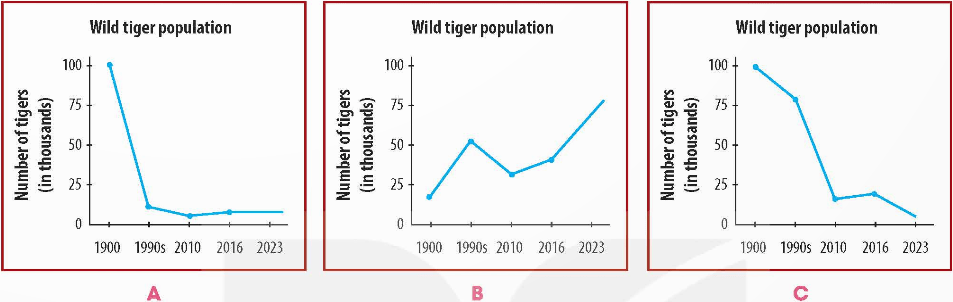
2. Which line graph shows the population of tigers over the past 100 years?
3. As their habitats become smaller, tigers _____.
A. look for food in forests
B. enter farmers' houses
C. attack farm animals
4. What have the tiger breeding farms led to?
A. The creation of conservation centres.
B. An increase in poaching.
C. A decrease in the use of tiger parts.
Đáp án
1. A
2. A
3. C
4. B
Nội dung bài nghe
As part of our series on wildlife, I'm going to talk about tigers today. First, let's take a look at the current situation. Over the last 100 years, the world's wild tiger population has declined significantly. At the beginning of the 20th century, there were 100,000 tigers in the wild. From an estimated 7,000-8,000 in the late 1990s, wild tiger numbers decreased by more than half in 2010. For the first time in 2016, there was a slight increase. However, there were still only about 4,500 wild tigers around the world in 2023. So, why are tigers endangered? What are the threats facing wild tigers?
First, tigers have lost a large part of their natural habitats. Their habitats have been destroyed or degraded by human activity. Forest clearance for agriculture and wood, as well as the building of roads and housing have forced tigers to survive in small, unnatural environments. As their habitats become smaller, they find it hard to find food. So they are forced to enter villages and attack farm animals, which often results in killing the tigers by the farmers.
However, the most serious threat facing tigers today is poaching and the illegal trade in tiger parts. Historically, tigers were poached for their skins used to make fur coats and home decorations. In addition, there is still demand for their bones, teeth, and other body parts, which are used to make traditional medicines. Nowadays, many people still believe tiger medicines can cure diseases although this has been proven to be wrong by scientists. The demand for tiger parts led to the creation of tiger breeding farms where tigers are bred in captivity and killed for their parts. These farms were originally set up with tiger conservation in mind, as a way to stop poaching. However, these breeding farms led to an increase in poaching.
What can we do to help save tigers? Well, we can...
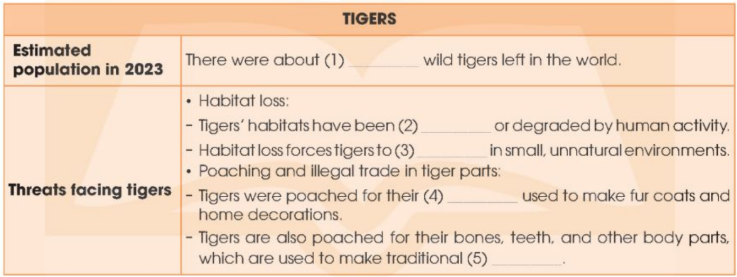
4. Listen to the talk again and complete the notes. Use ONE word or a number for each gap. Nghe lại bài nói và hoàn thành phần ghi chú. Sử dụng MỘT từ hoặc một số cho mỗi chỗ trống.
Đáp án
1. 4,500
2. destroyed
3. survive
4. skins
5. medicines.
Hướng dẫn dịch
| Hổ | |
| Dân số ước tính năm 2023 | Có khoảng 4.500 con hổ hoang dã còn lại trên thế giới. |
| Những mối đe dọa đối với hổ |
Mất môi trường sống - Môi trường sống của hổ đã bị phá hủy hoặc suy thoái do hoạt động của con người. - Mất môi trường sống buộc hổ phải sinh tồn trong môi trường nhỏ, không tự nhiên. Săn bắt và buôn bán trái phép các bộ phận của hổ - Những con hổ bị săn bắt lấy da để làm áo khoác lông và đồ trang trí trong nhà. - Hổ cũng bị săn bắt để lấy xương, răng và các bộ phận cơ thể khác, được sử dụng để làm thuốc truyền thống. |
5. Work in pairs. Discuss the following questions. Làm việc theo cặp. Thảo luận các câu hỏi sau đây.
Which threats are facing tigers in Viet Nam? Which one is the most serious? Những mối đe dọa nào đang đối mặt với hổ ở Việt Nam? Cái nào là nghiêm trọng nhất?
Đáp án
Tigers in Vietnam face several serious threats that endanger their survival. The primary threats to tigers in Vietnam include:
1. Habitat Loss and Fragmentation
Tigers need large, continuous habitats to thrive. However, deforestation, illegal logging, and land conversion for agriculture and human development have led to significant habitat loss and fragmentation in Vietnam. This reduces the space where tigers can live and hunt, making them more vulnerable to conflicts with humans.
2. Poaching and Illegal Wildlife Trade
Poaching for tiger parts (like bones, skin, and teeth) is one of the most significant threats. Tigers are hunted for traditional medicine, luxury items, and as trophies. In some cases, tigers are also captured alive and kept in captivity for illegal breeding programs or as exotic pets. The illegal wildlife trade in tiger parts is fueled by both local demand and international markets.
Hướng dẫn dịch
Hổ ở Việt Nam đang đối mặt với một số mối đe dọa nghiêm trọng đe dọa đến sự sống còn của chúng. Các mối đe dọa chính đối với hổ ở Việt Nam bao gồm:
1. Mất và phân mảnh môi trường sống
Hổ cần môi trường sống rộng lớn, liên tục để sinh tồn. Tuy nhiên, nạn phá rừng, khai thác gỗ trái phép và chuyển đổi đất đai cho nông nghiệp và phát triển con người đã dẫn đến mất mát và phân mảnh môi trường sống đáng kể ở Việt Nam. Điều này làm giảm không gian sống và săn mồi của hổ, khiến chúng dễ bị xung đột với con người hơn.
2. Săn trộm và buôn bán động vật hoang dã bất hợp pháp
Săn trộm các bộ phận của hổ (như xương, da và răng) là một trong những mối đe dọa nghiêm trọng nhất. Hổ bị săn bắt để làm thuốc cổ truyền, đồ vật xa xỉ và làm chiến lợi phẩm. Trong một số trường hợp, hổ cũng bị bắt sống và nuôi nhốt để phục vụ các chương trình nhân giống bất hợp pháp hoặc làm thú cưng độc lạ. Buôn bán động vật hoang dã bất hợp pháp các bộ phận của hổ được thúc đẩy bởi cả nhu cầu trong nước và thị trường quốc tế.
Trên đây là Soạn tiếng Anh 12 Global Success Unit 8 Listening đầy đủ nhất.


