Tiếng Anh 12 Unit 4 Communication and culture/ CLIL Global Success
Tiếng Anh 12 Unit 4 Communication and culture/ CLIL
Nằm trong bộ tài liệu Giải tiếng Anh 12 Kết nối tri thức theo từng Unit, Soạn tiếng Anh 12 Unit 4 Communication and culture/ CLIL giúp các em chuẩn bị bài tập SGK tiếng Anh hiệu quả. Trong bài viết này, chúng tôi sẽ hướng dẫn giải chi tiết Tiếng Anh 12 Unit 4 Communication and Culture/CLIL, cung cấp đáp án, gợi ý trả lời và giải thích dễ hiểu cho từng bài tập.
Everyday English
Making complaints and responding to them
(Phàn nàn và phản hồi lại lời phàn nàn)
1. Listen and complete the conversations with the expressions in the box. Then practise them in pairs.
(Nghe và hoàn thành đoạn hội thoại với các từ trong hộp. Sau đó thực hành chúng theo cặp.)
A. I promise
B. I want to complain about
C. I'm sorry to have to say this
D. there's nothing we can do about it
1.
Ms Lan: Hi, Μai. (1) ___________, but there is always loud music coming from your flat very late at night. I can't sleep because of the noise.
Mai: Oh, I'm so sorry, Ms Lan. (2) ___________ this will never happen again.
2.
Nam: Excuse me, (3) ___________ the bus services in the neighbourhood. Buses are always running late, especially during rush hour.
Conductor: I'm sorry, but (4) ___________. There are so many vehicles on the roads now that traffic moves very slowly.
Gợi ý đáp án
|
1. C |
2. A |
3. B |
4. D |
2. Work in pairs. Use the models in 1 to make similar conversations for these situations. One of you is A, the other is B. Use the expressions to help you.
(Làm việc theo cặp. Sử dụng các mẫu ở bài 1 để thực hiện những đoạn hội thoại tương tự trong những tình huống này. Một bạn là A, một bạn là B. Hãy sử dụng các cách diễn đạt để giúp bạn.)
1. A has recently moved to a busy urban area. He/She is attending a community meeting chaired by B, who is an urban planner. A is complaining to B about the frequent traffic jams in the area. B is giving a response.
2. B is attending a talk by A, a local government official, who is discussing problems in their city. B is complaining to A about the city's overcrowded living conditions. A is giving a response.
Useful expressions
Making complaints
• I'm afraid I have a complaint to make…
• Excuse me, I want to complain about ...
• I'm afraid there's a problem with/about…
• I'm sorry to say this, but…
• I'm angry about...
Positive response to complaints
• I'm so sorry, but this will never occur/ happen again.
• I'm sorry. We promise never to make the same mistake again.
Negative response to complaints
• Sorry, there is nothing we can do about it.
• I'm afraid, there isn't much we can do about it.
Gợi ý đáp án
1. A: Excuse me, I want to complain about the frequent traffic jams in the area. It affects the mutual space in our area, especially during rush hours.
B: I'm so sorry, but this will never occur again. We are currently working on a comprehensive traffic management plan to address these concerns.
2. B: I'm afraid I have a complaint to make, A. The living conditions in our city have become unbearable due to overcrowding. It's getting difficult to find affordable housing, and the infrastructure is strained.
A: Sorry, there is nothing we can do about it. Many people move to our city out of control.
Culture/ CLIL
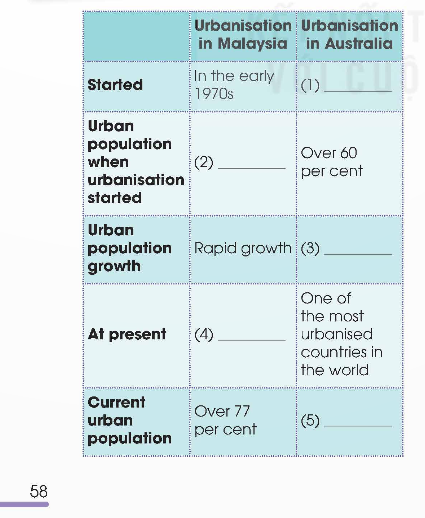
1. Read the text and complete the table.
(Đọc văn bản và hoàn thành bảng.)
URBANISATION IN MALAYSIA AND AUSTRALIA
Urbanisation in Malaysia started in the early 1970s. At that time, only around 26 per cent of the population lived in urban areas. After a period of rapid growth, the urban and rural populations were almost equal in the early 1990s. Since then, the urbanisation rate has continued to increase gradually. The urban population, for example, rose from 66 per cent in 2004 to 74 per cent in 2014.
At present, Malaysia is known as one of the most urbanised countries in Southeast Asia. It is also one of the most rapidly urbanised regions around the world. According to the latest statistics, over 77 per cent of Malaysia's total population now live in urban areas and cities.
Australia is an interesting example of early urbanisation, which started at the end of the 19th century. At that time, over 60 per cent of the population lived in urban areas. Since then, it has maintained a gradual growth. This was also due to the country's immigration policy, which encouraged people to settle in its coastal, urban areas.
Australia is now one of the most urbanised countries in the world, with almost 90 per cent of the population living in urban areas. The two largest cities of Australia, Sydney and Melbourne, are home to over 40 per cent of the country's population.
Gợi ý đáp án
(1) At the end of the 19th century
(2) Around 26 per cent
(3) Gradual growth
(4) One of the most urbanised countries in East Asia and one of the most rapidly urbanised regions around the world.
(5) Almost 90 per cent
2. Work in groups. Compare urbanisation in Viet Nam with that in Malaysia and/or Australia. Use the information in Writing and Culture/CLIL and the questions below to help you.
(Làm việc nhóm. So sánh quá trình đô thị hóa ở Việt Nam với Malaysia và/hoặc Australia. Sử dụng thông tin trong phần Viết và Văn hóa/CLIL và các câu hỏi bên dưới để giúp bạn.)
• Was the proportion of urban population in Viet Nam higher or lower than that in Malaysia/Australia in the 1970s?
• Which country has a faster urbanisation rate?
• Which one is more urbanised?
• What is the overall trend in urbanisation in each country?
Đáp án gợi ý
In the 1970s, the proportion of the urban population in Viet Nam was lower than that in Malaysia by around 10 per cent. Compared to Australia, the figure was almost 10 times smaller. Since the 1970s, in both Viet Nam and Malaysia, urbanisation has been increasing, but in Malaysia, the rate is faster. At present, about 40 per cent of Viet Nam's population lives in urban areas, while more than 77 per cent of Malaysia's and almost 90 per cent of Australia's population live in urban areas. Australia is one of the most urbanised countries in the world while Malaysia is the most urbanised country in Southeast Asia.
Hướng dẫn dịch
Vào những năm 1970, tỷ lệ dân số thành thị tại Việt Nam thấp hơn Malaysia khoảng 10%. So với Úc, con số này thấp hơn gần 10 lần. Kể từ thập niên 1970, quá trình đô thị hóa đã gia tăng ở cả Việt Nam và Malaysia, nhưng tốc độ tại Malaysia diễn ra nhanh hơn. Hiện nay, khoảng 40% dân số Việt Nam sống ở các khu vực thành thị, trong khi tỷ lệ này ở Malaysia là hơn 77% và ở Úc là gần 90%. Úc là một trong những quốc gia có mức độ đô thị hóa cao nhất thế giới, còn Malaysia là quốc gia có mức độ đô thị hóa cao nhất khu vực Đông Nam Á.
Trên đây là Soạn tiếng Anh 12 Global Success Unit 4 Communication and culture/ CLIL đầy đủ nhất. Hy vọng phần giải Tiếng Anh 12 Unit 4 Communication and Culture/CLIL – Global Success trên đây đã giúp các em hiểu rõ nội dung bài học và hoàn thành tốt các bài tập. Hãy chủ động vận dụng kiến thức đã học vào các tình huống giao tiếp thực tế, đồng thời mở rộng hiểu biết về văn hóa và truyền thông đại chúng.
>> Bài tiếp theo: Soạn tiếng Anh 12 Global Success Unit 4 Looking back


