Tiếng Anh 12 Friends Global Unit 2 2I Culture
Tiếng Anh 12 Unit 2 2I Culture Friends Global
Nằm trong bộ tài liệu Giải tiếng Anh 12 Friends Global theo từng Unit, Soạn tiếng Anh 12 Unit 2 2I Culture giúp các em chuẩn bị bài tập SGK tiếng Anh hiệu quả.
1. SPEAKING Work in pairs. Think of three important problems that the world faces today. How do you think we can solve them?
(Làm việc theo cặp. Hãy nghĩ đến ba vấn đề quan trọng mà thế giới ngày nay phải đối mặt. Bạn nghĩ chúng ta có thể giải quyết chúng bằng cách nào?)
Gợi ý đáp án
- Climate change: Invest in renewable energy sources such as solar, wind, hydro, and geothermal to reduce reliance on fossil fuels. Implement policies that promote energy efficiency and carbon pricing to incentivize businesses and individuals to reduce emissions.
- Inequality and poverty: Prioritize education and skills training programs, particularly in disadvantaged communities, to empower individuals with the knowledge and skills needed to access better job opportunities. Implement progressive taxation and social welfare policies to redistribute wealth and reduce income inequality.
- Global health crises: Invest in healthcare infrastructure, including hospitals, clinics, and medical supply chains, particularly in developing countries. Improve access to healthcare services through universal healthcare coverage and community-based healthcare initiatives.
2. Read the text. What solution did the British government suggest for a problem in the 18th century? Was it successful?
(Đọc văn bản. Chính phủ Anh đã đề xuất giải pháp nào cho một vấn đề ở thế kỷ 18? Nó có thành công không?)
The World's First GPS
On a stormy night in 1707, four ships struck rocks off the south coast of England and sank. One thousand, four hundred sailors were drowned. The ships had crashed because they had no way of knowing how far they had travelled in a particular direction; they could not calculate their longitude, which required accurate time measurement. It was the most serious in a series of accidents at sea, and a stunned British government decided to act. In such difficult circumstances, they believed that the best response to the disaster was a competition: the Longitude Prize.
The Longitude Prize was no ordinary competition. To win it, someone had to find a way of calculating how far a ship had travelled east or west from its point of departure. Geniuses such as Sir Isaac Newton had failed to find a solution, so to ensure the interest of Britain's greatest scientific minds, the government offered a prize of £20,000 - the equivalent of £2.6 million in today's money. But to everyone's surprise, it wasn't a famous academic who solved the problem, but an unknown carpenter. When John Harrison wasn't working with wood, he was making clocks. An accurate clock would allow sailors to calculate their position, but at the time it was thought impossible to create a mechanical clock that could work on a ship. The movement of the sea and the changes in temperature destroyed the delicate parts. However, after three frustrated attempts, Harrison's fourth sea clock, H4, finally triumphed. Its mechanics were so good that the H14 worked better than most clocks on land.
The Longitude Prize and Harrison's success generated a lot of interest in the 18th century, but it was soon forgotten. However, in 2013, the British government created a new Longitude Prize, offering £10 million to the person who could solve a great challenge to humanity. An enthralled public then took part in a TV programme where viewers chose one challenge from a list of six for scientists to focus on. The question now is, will someone be able to solve it just as well as Harrison solved the challenge presented to him?
Gợi ý đáp án
In the 18th century, the British government suggested the solution of creating an accurate clock to address the problem of calculating longitude at sea.
This solution proved to be successful when John Harrison, a relatively unknown carpenter and clockmaker, invented the marine chronometer, specifically his fourth sea clock known as H4.
3. Read the text again. Answer the questions.
(Đọc văn bản một lần nữa. Trả lời các câu hỏi.)
1 What was the situation that the British government decided to deal with?
2 What surprised people about the winner of the Longitude Prize?
3 Why didn't sailors use mechanical clocks to calculate their positions?
4 Why do you think the successful sea clock was called H4?
5 How was the challenge for the new Longitude Prize decided on?
Gợi ý đáp án
1 - The British government decided to try to prevent the kinds of accidents that had happened at sea in 1707.
2 - He was a carpenter rather than a well-known scientist.
3 - Because conditions on board damaged the clocks.
4 - The H probably refers to the first letter of the inventor’s surname (Harrison), and the number 4 to the fact that it was the fourth sea clock that he had made.
5 - A TV audience was asked to choose one challenge from a list of six.
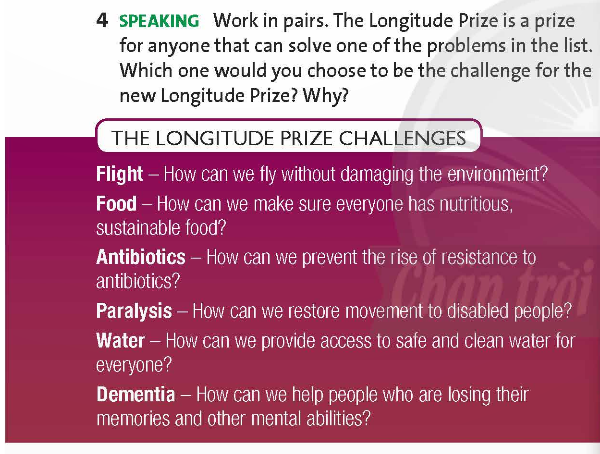
4. SPEAKING Work in pairs. The Longitude Prize is a prize for anyone that can solve one of the problems in the list. Which one would you choose to be the challenge for the new Longitude Prize? Why?
(Làm việc theo cặp. Giải Longitude là giải thưởng dành cho ai có thể giải quyết được một trong các vấn đề trong danh sách. Bạn sẽ chọn cái nào là thử thách cho Giải Longitude mới? Tại sao?)
Gợi ý đáp án
I would choose antibiotics because of long – term impact. Developing strategies to prevent antibiotic resistance would have long-term benefits by preserving the effectiveness of existing antibiotics and ensuring their availability for future generations. This would help sustainably manage infectious diseases and improve healthcare outcomes globally.
5. Listen to a podcast. Which problem from exercise 4 was chosen as the challenge for the Longitude Prize?
(Nghe một podcast. Vấn đề nào trong bài tập 4 được chọn làm thử thách cho Giải Longitude?)
Gợi ý đáp án
How can we prevent the rise of resistance to antibiotics?
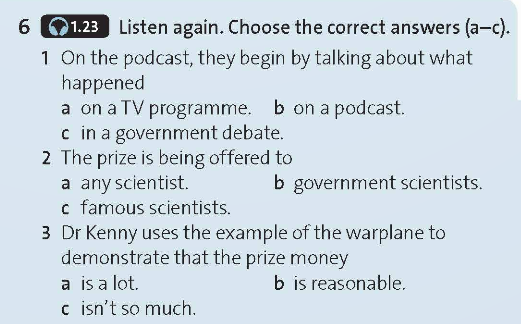
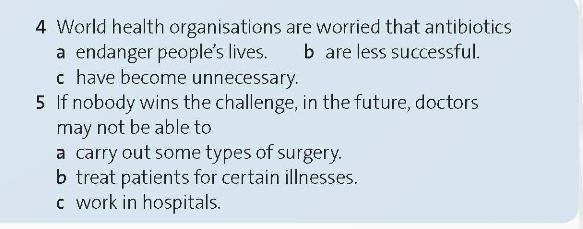
6. Listen again. Choose the correct answers (a–c).
(Lắng nghe một lần nữa. Chọn câu trả lời đúng (a–c).)
Gợi ý đáp án
|
1. a |
2. a |
3. c |
4. b |
5. a |
7. SPEAKING Work in pairs. What important problem in the world would you add to the list in exercise 4?
(Làm việc theo cặp. Vấn đề quan trọng nào trên thế giới bạn sẽ thêm vào danh sách trong bài tập 4?)
Gợi ý đáp án
Energy - How can we transition to renewable energy sources and achieve carbon neutrality?
Education - How can we ensure access to quality education for all, especially in underserved communities?
Biodiversity Loss - How can we halt and reverse the loss of biodiversity and protect endangered species and ecosystems?
Gender Equality - How can we achieve gender equality and empower women and girls worldwide?
Healthcare Access - How can we ensure equitable access to affordable and quality healthcare for all, regardless of income or location?
Trên đây là Soạn tiếng Anh 12 Friends Global Unit 2 2I Culture đầy đủ nhất.
>> Bài tiếp theo: Soạn tiếng Anh 12 Friends Global Review Unit 2


